Last updated: October 2026
Do fall-asleep tricks work? Yes, partly: the relaxation machinery inside them has clinical backing, while the two-minute promises attached to them do not. Ranked by evidence, muscle relaxation comes first, slow breathing is mixed, and cognitive shuffling rests on preliminary data.
Key takeaways
- The American Academy of Sleep Medicine gives relaxation therapy a conditional recommendation as a single-component therapy, and suggests clinicians not use sleep hygiene on its own (AASM 2021 guideline).
- A 2026 meta-analysis of 14 randomised trials and 957 participants found progressive muscle relaxation improved subjective sleep quality (Hedges g = −1.24, 95% CI −1.71 to −0.77 — a large effect, but on a questionnaire score rather than on how fast sleep arrived), while the benefit did not reach significance in adults aged 55 and over.
- Slow breathing has two small studies pointing opposite ways rather than a settled answer: 14 self-reported insomniacs fell asleep faster after 20 minutes of paced breathing, while a 20-person crossover trial found no effect on sleep latency at all.
- Cognitive shuffling’s own data is a 2015 conference poster labelled “preliminary”; its mechanism borrows from a 2002 trial of 41 people with insomnia00012-2) in which imagery distraction shortened reported sleep onset.
- The military method’s provenance is a 1981 book by track coach Bud Winter, not a clinical trial — its tested ingredients are muscle release and imagery.
- None of the three was studied as a two-minute promise; all were studied as a practice repeated over nights or weeks, so one restless night is not a fair test of any of them.
What are the three fall-asleep tricks?
A fall-asleep trick is a short mental or physical routine performed in bed to shorten the gap between lights-out and sleep. Three dominate the search results, and they are not variations on one idea — each targets a different part of the problem.
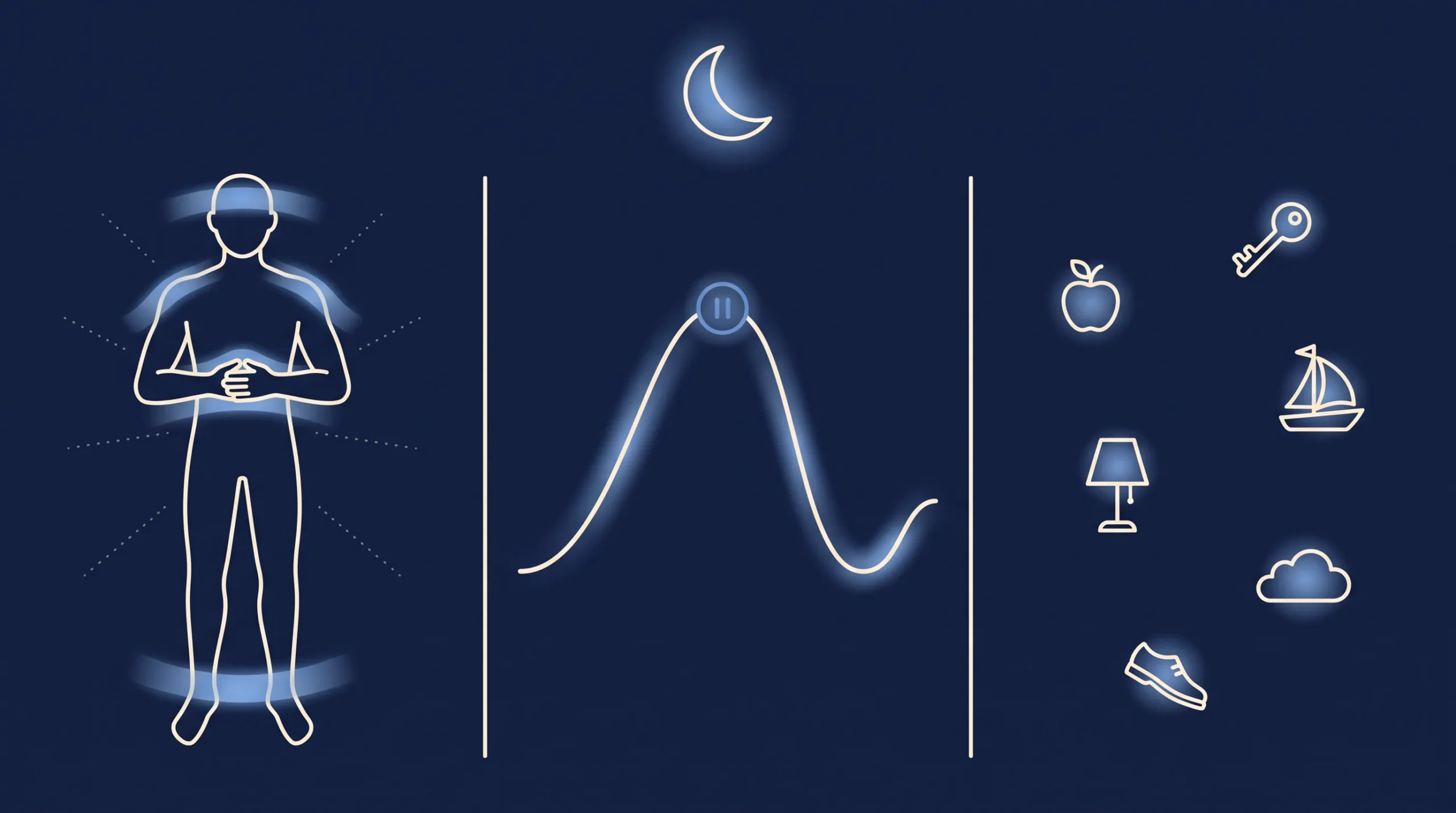
The military method is a sequence: release the face, drop the shoulders and arms, exhale and let the chest go, then release the legs, and finish with about ten seconds of a blank or still image. 4-7-8 breathing is a fixed count — inhale for four, hold for seven, exhale for eight — repeated for a handful of cycles. Cognitive shuffling asks you to picture a stream of unrelated objects, one every few seconds, deliberately avoiding any sequence that tells a story.
Notice what separates them: the first is a muscle protocol, the second a breathing protocol, the third an attention protocol. That distinction decides everything below, because the evidence sits unevenly across the three — which means the honest way to judge a trick is to judge its ingredients.
Which part of these tricks does the evidence actually support?
The clearest answer comes from the guideline that sets clinical practice. In 2021 the American Academy of Sleep Medicine published a GRADE-based clinical practice guideline for chronic insomnia in adults. It issued one strong recommendation — multicomponent cognitive behavioural therapy for insomnia — and four conditional ones, including: “We suggest that clinicians use relaxation therapy as a single-component therapy.”
The same guideline is unusually blunt about the advice most people meet first: “We suggest that clinicians not use sleep hygiene as a single-component therapy.” Lead author Jack Edinger put it plainly in the AASM announcement: “sleep hygiene recommendation do not constitute an effective stand-alone therapy.”
So the supported category is relaxation therapy as a class. No guideline endorses a branded sequence or a named count — when a video promises a two-minute result, the promise is the part without backing, not necessarily the practice underneath it.
Does the military method work in two minutes?
The method is usually traced to Relax and Win, a 1981 book by the American track coach Lloyd “Bud” Winter, whose publication record appears in the Open Library catalogue. The sequence entered popular use through sports coaching, and the two-minute figure travelled with it.
Its ingredients, though, are the ones researchers have measured, and progressive muscle relaxation — tensing and releasing muscle groups in order — is the closest tested analogue. A 2026 systematic review and meta-analysis in Frontiers in Public Health pooled 14 randomised controlled trials covering 957 adults and reported improved sleep quality with a pooled effect of Hedges g = −1.24 (95% CI −1.71 to −0.77, p < 0.001). Two details in that paper deserve as much attention as the headline. Heterogeneity was high (I² = 85.5%), meaning the trials disagreed considerably with each other. And in the age subgroup, the benefit held for adults under 55 (g = −1.40) but the confidence interval for adults 55 and over crossed zero, so the effect in that group remains uncertain.
One more line from the same analysis cuts against the “quick fix” reading: meta-regression found no significant association between the number of relaxation sessions and sleep quality (p = 0.21). The outcome measured was a questionnaire score for overall sleep quality, not a stopwatch on how long falling asleep took.
Does 4-7-8 breathing shorten the time it takes to fall asleep?
Here the evidence genuinely conflicts, which is why honest answers to this question are rare.
On the supporting side, a study in Psychophysiology had 14 self-reported insomniacs and 14 good sleepers practise paced breathing at a slow rate before bed. For the insomnia group, sleep onset latency, number of awakenings and time awake during the night all decreased, and sleep efficiency increased, after 20 minutes of slow paced breathing at 0.1 Hz.
On the other side, a randomised crossover trial measured 20 young adults across 40 polysomnography nights, comparing a 30-minute slow breathing session with music listening and with no intervention. Heart rate variability rose immediately in both intervention conditions. But the authors reported that, contrary to their hypotheses, they found no effects of the interventions on the length of the sleep latency, and concluded that “neither condition had robust effects on sleep quality.” What they did see in the slow-breathing arm was higher central delta power during deep sleep across the night.
Both studies are small — 14 and 20 participants — which is the real state of this literature rather than a flaw in one paper, and the question is live enough that Sleep Medicine Reviews published a systematic review of bedtime slow-breathing techniques in 2026. For now, slow breathing may calm the autonomic nervous system reliably while moving the clock only sometimes.
Does cognitive shuffling work, and how strong is its evidence?
Cognitive shuffling has the most interesting theory and the thinnest direct data. Its originator, Luc Beaudoin, derived it from a theory that the fragmented, incoherent mental imagery of normal sleep onset does not merely accompany falling asleep but promotes it — so deliberately generating disconnected images may imitate that state.
The study everyone cites is a conference presentation given at CogSci 2015 by Digdon and Beaudoin, which compared the technique against constructive worry. The record for that presentation describes it as “Preliminary results” and notes that data collection was expected to be complete by the end of October 2015. Beaudoin later published a 2019 abstract in Sleep Medicine proposing that the technique be experimentally tested against alternatives — a proposal, not a result.
The mechanism, however, has older support. In a 2002 trial in Behaviour Research and Therapy, 41 people with insomnia spent one night either using imagery to distract themselves from unwanted pre-sleep thoughts, distracting themselves without instruction, or following their usual routine. Both distraction groups reported shorter sleep onset latency than the control group00012-2), and the imagery group also rated their pre-sleep thoughts as less distressing. That is a one-night study of 41 people, so it suggests a direction rather than settling one — but it is the most relevant evidence the shuffle family has.
4 things that decide whether a trick works tonight
- What is keeping you awake. All three target mental arousal — a racing mind, replayed conversations, tomorrow’s list. What causes insomnia separates these drivers from the physical ones.
- Your timing. A technique applied 90 minutes before your body is ready is working against your circadian rhythm, and no amount of counting outruns that.
- Repetition. The relaxation trials ran over sessions and weeks, so judging any of these on one bad night tells you very little — the mistake most “it didn’t work for me” reviews make.
- Everything else in the hour before bed. Screens, caffeine timing and wind-down matter enough that they have their own evidence base; the hour before bed without screens covers what fills that window.
How the three methods rank on evidence
| Method | What it targets | Strongest evidence | Honest verdict |
|---|---|---|---|
| Military method | Muscle tension, then imagery | Relaxation therapy carries a conditional AASM recommendation; progressive muscle relaxation pooled across 14 RCTs, 957 adults | Mechanism supported as a class; the two-minute claim comes from a 1981 book |
| 4-7-8 breathing | Autonomic arousal | One 14-person study found shorter sleep onset; one 20-person crossover found none | Mixed and small; it may calm you without speeding sleep onset |
| Cognitive shuffling | Attention and rumination | A 2015 preliminary conference poster; related imagery-distraction trial in 41 people | Plausible mechanism, weakest direct data |

Read down the “honest verdict” column and a pattern appears: the better-evidenced a method is, the more modest its marketing. Methodology: this ranking is based on published clinical practice guidelines and peer-reviewed trials, with any product dimensions taken from the makers’ production specs. It describes general sleep quality, not treatment for a diagnosed condition.
Frequently asked questions
Which fall-asleep trick has the most evidence?
Progressive muscle relaxation, the mechanism underneath the military method. It is the only one of the three whose family carries a conditional recommendation in the AASM’s 2021 clinical practice guideline, and the only one with a pooled meta-analysis behind it — 14 randomised trials and 957 adults, reporting improved subjective sleep quality.
Is the two-minute claim for the military method true?
There is no clinical trial of the branded two-minute sequence to support it. The figure travelled with the technique from Relax and Win, a 1981 coaching book. The underlying practice of releasing muscle groups in order has been tested; the stopwatch promise attached to it has not.
Does 4-7-8 breathing help if I do not have insomnia?
It may help you feel calmer. The trial that measured 20 healthy young adults found immediate increases in heart rate variability but no change in how long it took them to fall asleep. If your nights are generally fine, breathing exercises are low-risk and may be pleasant without being decisive.
How long should I give a technique before deciding it failed?
Longer than one night. The relaxation trials in the meta-analysis delivered the practice over multiple sessions, and the cognitive shuffling poster followed students across a semester. A single restless night is not an informative test of any of them.
Do these tricks replace treatment for chronic insomnia?
No. The AASM reserves its one strong recommendation for multicomponent cognitive behavioural therapy for insomnia. If difficulty sleeping has persisted for months or affects your days, this is a conversation for a doctor or sleep clinician, not a breathing count.
Why do the tricks sometimes work and sometimes not?
Because they only address mental arousal. When the obstacle is physical — a room that is too warm, a loft that tips your neck, pain, or light leaking in — a technique aimed at your thoughts has nothing to work on, and you may feel calm and still awake.
Where a trick ends and your setup begins
The most useful thing these three methods have in common is their limit. Each works on mental arousal, which is one driver of a slow night among several — and the only one any of them touches. That is worth knowing before you decide a technique failed you: if what is keeping you awake is light, temperature, pain or an awkward angle at the neck, a breathing count has nothing to act on, and you can end up calm and still awake. Why you feel tired even after a full night’s sleep walks through the same split.
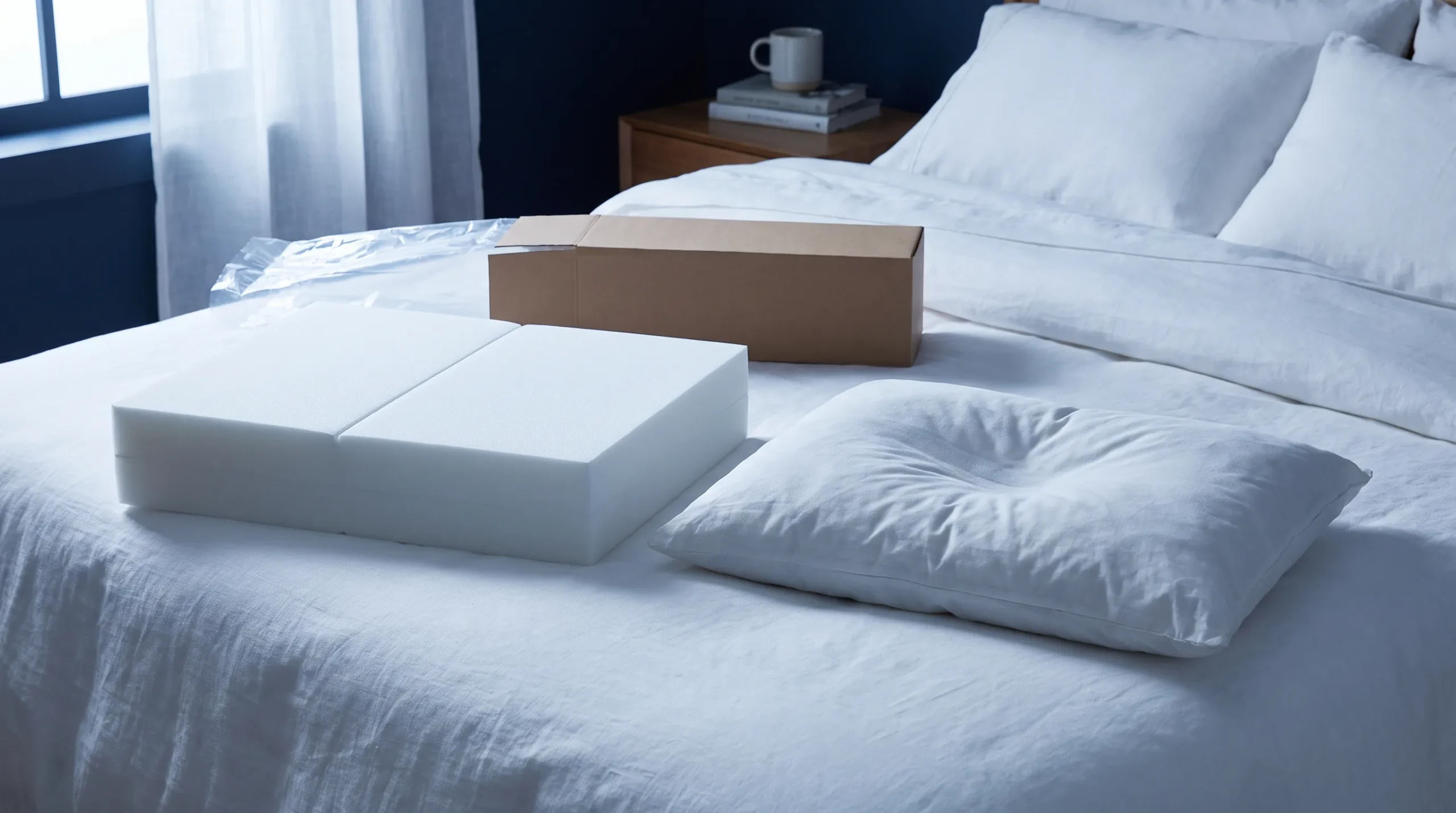
The practical move is not to drop the technique but to rule out the cheap physical variables alongside it, and head support is the cheapest to check. What counts as the right loft is not a matter of taste, but it is also not one number: your shoulder width, the position you settle into and how far the mattress lets that shoulder sink all decide where your neck lands. A contour shape such as the Aeris Contour Pillow holds two fixed lobes, 12 cm and 10 cm, which makes the height a known quantity rather than whatever the pillow has collapsed to — useful mainly because it lets you change one variable at a time. A new pillow that feels worse and what helps with neck pain in bed cover how to read that signal, and the practical guide to better sleep puts the two halves together.
Advertisement

FirmNest Extra Firm Pillow
64 × 40 × 14 cm, 1.5 kg extra-firm memory-foam core.
See the FirmNest Extra Firm Pillow on AmazonProducts mentioned in this guide
 Aeris Contour Pillow — 60 × 40 cm memory foam, 12 cm and 10 cm contour lobes
 FirmNest Extra Firm Contour Pillow — same 60 × 40 cm contour shape, extra-firm core, 1.4 kg