Last updated: October 2026
The best firm pillow is the one that still holds your head level at 3 am. Firmness is resistance to compression, not height — and it only helps if your current pillow is collapsing under your head rather than sitting too high.
Key takeaways
- Firmness has a formal definition: the foam industry measures it as Indentation Force Deflection, the force needed to indent foam by 25% of its height. It is a surface property, not a height.
- Firmness and density are not the same thing. That same source states firmness “is independent of foam density”: high-density foams can be soft, low-density foams firm.
- The borrowable home test comes from an 84-patient pillow study: under a hand-applied load of about 4 kg, roughly a head’s weight, the pillow should sink no more than 5 mm.
- Neck pain scores in that study fell from 6.8 to 5.1 at two weeks and 4.1 at three months — but there was no control group, so it describes what happened rather than proving cause.
- Fill matters at the extremes: in a five-pillow field trial latex left 90.9% of participants free of waking headache against 63.3% on feather, and contour foam did no better than plain foam.
- A meta-analysis of nine high-quality trials covering 555 participants found pillow design did not influence sleep quality, and put cervical alignment down mainly to shape and height — so “firmer” is not an upgrade path, it is the answer to one specific failure.
What makes a pillow firm, and how is firmness measured?
Firmness is how hard the filling pushes back, and the bedding industry has a number for it. The Polyurethane Foam Association defines firmness as Indentation Force Deflection: the force in pounds needed to compress a foam sample by 25% of its original height. Higher IFD means a surface that yields less to the first push.
That is only the first centimetre of the story, which is why pillows can feel firm in the shop and flat at 3 am. The same source describes a second measurement at 65% compression and calls the ratio between the two the foam’s support factor — typically 1.5 to 2.6, where higher numbers mean more ability to carry weight without, in its words, “bottoming out”. A low-IFD foam with a high support factor feels soft at the surface and still refuses to collapse. That combination, not raw hardness, is usually what a sleeper is reaching for.
Two further properties decide what happens over months. Resilience is measured by dropping a steel ball and recording the rebound, roughly 20% to 80%; viscoelastic foams sit at the very low end by design, which is why memory foam feels slow even when firm. Flex fatigue testing compresses a sample thousands of times and records the percentage of IFD lost — the laboratory version of the pillow that was supportive in March and isn’t in July.
Firmness, loft or density — which one is your actual pillow problem?
These three get used interchangeably in product copy and are not interchangeable at all. Loft is height. Firmness is resistance to compression. Density is mass per unit volume. You can buy a tall soft pillow, a short firm one, or any combination.
The correction worth making is on density, because “high-density” does heavy lifting in a lot of listings. Firmness, the foam association states, is independent of density. What density does predict is longevity: typically, the higher the polymer density, the better the foam retains its original properties and support. Density is a durability claim, not a firmness claim.
| Property | What it measures | How you notice it | What it does not tell you |
|---|---|---|---|
| Loft | Height of the pillow, unloaded | Head sits high or low at bedtime | Whether that height survives the night |
| Firmness (IFD) | Force to indent the foam 25% | Surface feel in the first seconds | Behaviour under a full head load |
| Support factor | 65% IFD divided by 25% IFD | Whether it bottoms out or holds | How it feels to the hand in a shop |
| Density | Mass per unit volume | Weight of the pillow in your hands | How firm it is |
| Resilience | Ball rebound, 20–80% | Springy versus slow and sinking | Durability on its own |
If you keep buying loftier pillows and still wake up flat, firmness and support factor are the variables you have not been buying. If your head feels propped and your chin tucks toward your chest, more firmness makes that worse and the answer is less loft. Our guide to fitting a high-loft pillow covers the height side of the choice.
Who gets the most from a firm or extra-firm pillow?
The clearest case is a side sleeper with broad shoulders. Side lying leaves a gap between the outer edge of the shoulder and the side of the head, and the pillow has to fill it all night, not just at lights-out. The bigger the gap, the more loft is needed and the more load that loft carries — which is where a low support factor shows up as a sagging neck by morning. Our pillow guide for side sleepers covers that measurement.
There is indirect support for taking the collapse seriously. In a study using two nights of infrared video in 53 people’s own bedrooms, participants with morning neck symptoms spent about twice as long in what the researchers classed as provocative side lying — a median 153 minutes a night against 75 in the control group — and changed position more often, 23.6 times versus 18.3. The authors are explicit that a cross-sectional design cannot show which way the arrow points. What it does show is that a neck held out of neutral for hours is the pattern tracking with waking symptoms, and a flattened pillow is one way to get there.
The second clear case is a complaint about time: right in week one, wrong a month later. That is flex fatigue in plain language — a firmness-retention problem, not a height problem.
4 signs an extra-firm pillow is the wrong pillow for you
Firmness is a tool with a narrow job. Four patterns suggest the job is a different one:
- You wake with your chin tucked toward your chest. Your head is already above neutral, and firmness holds it there more insistently.
- You sleep mostly on your stomach. Prone sleeping keeps the neck rotated for hours and loft adds to that angle; the question is how little support to use, not how firm.
- Your issue is the shape of the support, not its collapse. If you are chasing the fit under the curve of the neck, a contour pillow is the shape adjustment, and our neck pain guide is the better starting point.
- You like the sensation of sinking in. An extra-firm core will read as hard rather than supportive, and comfort decides whether you stay on the pillow at all.
One signal sits outside bedding entirely: pain, numbness or pins and needles travelling down an arm or into the hand is a question for a clinician, not a pillow purchase.
Does a firmer pillow reduce neck pain, or just feel different?
The evidence for firmness is thinner than the marketing, and the strongest findings point at height and shape instead. The meta-analysis in Clinical Biomechanics pooled nine high-quality trials covering 555 participants and found significant effects favouring rubber pillows for neck pain (standardised mean difference −0.263, p < 0.001), waking pain (−0.228, p < 0.001) and neck disability (−0.506, p = 0.020). Its interpretation, though, was that side-lying cervical alignment may not change much with the material, and "may be significantly impacted by the shape and height of the pillow".
The field trial behind much of that literature agrees. Participants slept seven consecutive nights on each of five pillows — polyester, regular foam, contour foam, feather and latex — with a week on their own pillow between each. Latex came out best: 90.9% reported no waking headache against 63.3% on feather, and 67.5% no waking cervical stiffness against 49.2%. The authors recommended latex over any other type for waking headache and arm pain, and advised against feather. The contour foam pillow performed no better than the plain foam one.
Latex and feather sit at opposite ends of how much a fill collapses under a head, which makes that readable as a support story — but the trial measured symptoms, not firmness, so the mechanism stays an inference. And own pillows were no clean baseline: 33.9% of participants reported waking cervical stiffness on them, which is why the authors called an own pillow a questionable control.
The one study built around firmness fitted loft individually for 84 patients and made every pillow to the same hardness rule. Mean neck pain fell from 6.8 at baseline to 5.1 at two weeks and 4.1 at three months. It had no control group — the authors list that as its major limitation — so the right reading is “this is what happened”, not “the firmness did it”.
Will a firm pillow help you sleep better overall?
Probably not, and that is one of the firmer findings in the literature. Across those nine high-quality trials, pillow design had essentially no effect on sleep quality: a standardised mean difference of 0.047, p = 0.703. Pillow choice moved waking neck symptoms; it did not move how well people slept.
So treat firmness as an alignment decision and sleep quality as a separate project. For light, timing, caffeine and routine, start with our better sleep guide and the practical tips for getting better sleep.
How do you test a pillow’s firmness before you commit?
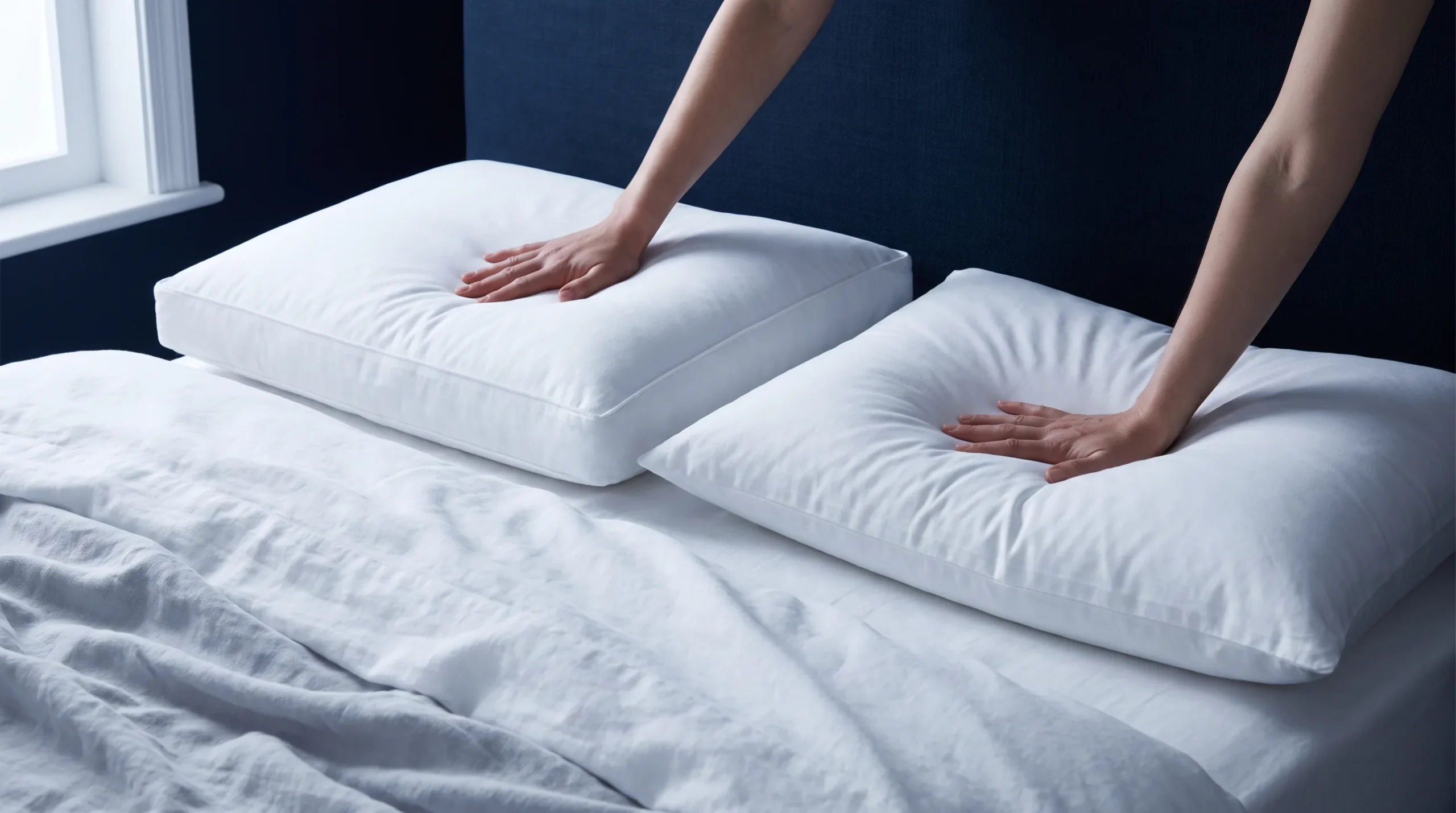
Borrow the research criterion. In the 84-patient study the pillow was compressed by hand with a load of about 4 kg, chosen because that is roughly what an adult head weighs, and had to sink no more than 5 mm under it. The researchers read the load off a kitchen scale and measured the sink with a ruler in 1 mm steps, which makes it reproducible at home: press until a scale under your hand reads about 4 kg, then measure what the surface gave up.

Two cheaper checks catch the other failure modes. Lying on your side, nose, chin and breastbone should sit roughly in one line, and a phone photo from behind shows this far better than feel does. A pillow you routinely fold, stack or shove under your shoulder is being corrected by your sleeping self: folding doubles the loft, pushing it away removes it. If you wake in a different position from the one you fell asleep in, our guide to why sleep positions change at night separates the normal from the pillow-driven.
| What you observe | Most likely variable | What more firmness would do |
|---|---|---|
| Head sinks to the mattress by morning | Firmness and support factor | The point of the change |
| Chin tucked toward chest on waking | Too much loft | Make the angle more insistent |
| Right in week one, wrong by week six | Firmness retention (flex fatigue) | Help, if density is also higher |
| One-sided ache, same every morning | Loft mismatch for your shoulder | Little, until the height is right |
| Poor sleep, no neck symptoms | Not the pillow | Nothing measurable |
Frequently asked questions
Is a firm pillow better for your neck?
Only if your head is sinking out of line. The pooled evidence favours shape and height over material for side-lying alignment, so firmness is best treated as the fix for a collapsing pillow rather than a general upgrade. A pillow holding your head above neutral can bend the neck much as a sagging one does.
What does “extra firm” actually mean on a pillow listing?
Usually nothing standardised. The foam industry measures firmness as Indentation Force Deflection, the force to compress a sample by 25%, but very few bedding listings publish an IFD figure. “Extra firm” is a marketing tier rather than a specification, and the 4 kg sink test is the more reliable guide.
Does high density mean a firmer pillow?
No. The Polyurethane Foam Association states that firmness is independent of density, and that high-density foams can be soft while low-density foams can be firm. What higher polymer density typically predicts is durability: better retention of the foam’s original properties over time.
Why does my pillow go flat overnight?
Because the fill gives way under sustained load, which is a support-factor problem rather than wear. Laboratory flex fatigue tests measure the same thing over months, as the percentage of firmness lost after thousands of compressions. A pillow can be both soft and worn, and the two feel identical at 6 am.
Should stomach sleepers use a firm pillow?
Prone sleeping holds the neck rotated for hours, and extra loft increases that angle rather than reducing it, so the useful direction for a stomach sleeper is less support rather than firmer. If mornings are consistently uncomfortable, the position itself is the larger variable.
Firm pillow or contour pillow — which should I pick?
They solve different problems. Firmness addresses a pillow that will not hold its height; a contour shape addresses the fit under the neck. Worth knowing first: in the five-pillow field trial, the contour foam pillow performed no better than the plain foam one on waking symptoms.
Choosing between firm and extra-firm
If your reading of this page pointed at collapse rather than height, the question is how much load the core has to carry — a broad-shouldered side sleeper on a firm mattress asks more of a pillow than a back sleeper on a soft one. The figures below come from each maker’s production spec, and both share the same 60 × 40 cm footprint, so the difference between them is the core rather than the shape.
The FirmNest Extra Firm Contour Pillow pairs an extra-firm core with contour edges of 12 cm and 10 cm, for sleepers who want the height to hold and the shape to stay put. The Aeris Contour Pillow uses the same two-loft profile in a standard memory foam core, the better starting point if this page suggested you are already propped too high. For the lower-back version of the question, see our best pillow for lower back pain guide.
Advertisement

FirmNest Extra Firm Pillow
64 × 40 × 14 cm, 1.5 kg extra-firm memory-foam core.
See the FirmNest Extra Firm Pillow on AmazonProducts mentioned in this guide
 FirmNest Extra Firm Contour Pillow — 60 × 40 cm, 12 cm and 10 cm contour edges, 1.4 kg extra-firm core
 Aeris Contour Pillow — 60 × 40 cm, 12 cm and 10 cm contour edges, 1.4 kg memory foam