Last updated: September 2026
The best pillow for lower back pain is the one that keeps your pelvis neutral: between the knees if you sleep on your side, under them if you sleep on your back. No pillow treats back pain itself.
Key takeaways
- Low back pain affected 619 million people in 2020 and is the single leading cause of disability worldwide (WHO) — and in about 90% of cases it is non-specific, with no disease or structural cause identified.
- In a randomised, double-blind trial of 313 adults with chronic non-specific low back pain, a medium-firm mattress beat a firm one at 90 days: odds ratio 2.36 for pain in bed, 2.10 for disability (Kovacs et al., The Lancet).
- A 2026 review of 47 studies agreed: medium-firm is “the most defensible general recommendation”, though the choice also turns on body build, age and sleep position.
- Among 375 consecutive patients referred for chronic low back pain in Finland, 87% slept on their side, 47% on their back, 22% face-down; pain disturbed sleep in 77% (cross-sectional study).
- People waking with lumbar symptoms did not differ from symptom-free controls in posture changes or time in provocative postures (video-scored research in PLOS ONE) — position alone did not separate the groups.
- In that study, three participants scored as provocative side lying were re-classified as supportive because pillows or a duvet held up the upper thigh, so no spinal rotation or extension was induced.
- Sleeping badly tracks with more back pain later: among 1,955 healthcare workers, poor sleep at baseline carried an odds ratio of 2.05 (95% CI 1.57–2.69) for higher pain intensity a year on (prospective cohort).
Why does lower back pain get worse in bed?
Partly because there is so much of it to begin with. The WHO puts the 2020 figure at 619 million people, projects 843 million by 2050, and classes roughly nine in ten cases as non-specific — pain that cannot be pinned to a disease, a fracture or a damaged structure. A support pillow is a comfort intervention, aimed at exactly that non-specific majority.
The in-bed part is not rare either. In the Finnish clinic study, over 90% of chronic low back pain patients reported significant discomfort in bed, on getting up, or both; three-quarters named particular sleeping positions as making their pain worse.
Why lying down should provoke anything is argued rather than settled. Those authors note that body weight is distributed more evenly on your back or front, but that both positions may increase lumbar lordosis and in turn load the lumbar facet joints; face-down sleeping has separately been linked on MRI to ligamentum flavum buckling and facet joint changes. Those are observations about loading, not proof that your bed caused your morning ache — and if you wake unrefreshed for unrelated reasons, why you feel tired after a full night’s sleep is the better start.
Does your sleeping position actually cause lower back pain?
The cleanest test of that question returned a null result. Researchers filmed 53 adults with infrared cameras over two nights and scored every posture held for a minute or longer as supine, supportive side lying, provocative side lying or prone, grouping participants by whether they woke with cervical symptoms, lumbar symptoms or none.
The neck group looked different from the controls: more posture changes, roughly twice as long in provocative side lying. The lumbar group did not. They averaged 22.9 posture changes against the controls’ 18.3, a gap short of significance, and their time in provocative postures was likewise statistically indistinguishable. Whatever woke them with a sore back, a headcount of positions did not capture it.
The clinic data points the same way. Prone was avoided most, yet side lying — the position 87% of patients used — was linked to higher disability scores and more referred leg pain, and the authors argue for personalised guidance rather than one recommended posture. Positions differ in what they load, and you change position about eighteen times a night regardless.

Where should the pillow go for lower back pain — knees or waist?
For side sleepers the best-documented answer is between the knees, and the evidence arrives sideways. In the PLOS ONE data analysis, three participants were technically in provocative side lying — top thigh advanced forward of the bottom thigh — but were re-classified as supportive, because pillows or a duvet held that upper thigh up and no spinal rotation or extension was induced.
That is a footnote inside a larger study, not a trial of knee pillows — but it is the most direct published evidence we found that a pillow between the legs changes what a side-lying position asks of the spine.
For back sleepers the usual suggestion is a pillow under the knees, the mirror image of the same idea: ease the pull drawing the lower spine into extension. We looked for a controlled trial of that setup and found none, so treat it as something cheap to test for a week rather than something demonstrated. The same caution applies to the lumbar roll behind the waist in bed, which our earlier version of this page recommended more confidently than the literature justifies.
| If you sleep | The support usually goes | What it is aiming at | How strong is the evidence |
|---|---|---|---|
| On your side | Between the knees | Stopping the top thigh dropping forward and rotating the pelvis | Indirect — the PLOS ONE re-classification note |
| On your back | Under the knees | Easing the pull into lumbar extension | Mechanism only; no controlled trial found |
| Face-down | No pillow placement fixes it | Prone was the most avoided position in the clinic study | Observational, and consistent across sources |
| Any position, old mattress | Replace the surface, not the pillow | Firmness as measured, not as marketed | Randomised trial plus two reviews |
4 things that decide whether a support pillow works
- Where it sits. A support between the knees and one behind the waist do different jobs: the first addresses pelvic rotation in side lying, the second the lumbar curve in supine. Using one in the other position is the most common way people conclude that support pillows do nothing.
- Whether it still has its shape at 5 am. A core compressed flat by midnight is no longer holding anything. Same trade-off as head pillows in our guide to extra-firm support: bedtime loft is only useful if it survives the night.
- Its depth against your own build. The 2026 review makes the point for sleep surfaces and it carries over: body habitus, age and sex-related anthropometry all change what “enough support” means. A block deep enough to hold a broad-hipped sleeper’s pelvis level will push a narrow-hipped one out of line.
- What is underneath it. If the mattress is the variable doing the damage, a knee pillow is a small correction on top of a large error — and the trial evidence below is far stronger for the surface than for anything placed on it.
Is your mattress the real problem?
Often, yes — and this is the one part of the topic with a proper randomised trial behind it. Kovacs and colleagues recruited 313 adults with chronic non-specific low back pain who ached in bed and on rising, then randomly assigned mattresses rated on the European Committee for Standardisation scale, where 1.0 is firmest and 10.0 softest: firm at Hs 2.3, or medium-firm at Hs 5.6.
At 90 days the medium-firm group had better outcomes on all three primary endpoints. The authors’ conclusion is unusually plain for a clinical paper: a mattress of medium firmness improves pain and disability in chronic non-specific low back pain.

| Outcome at 90 days | Odds ratio, medium-firm vs firm | 95% confidence interval |
|---|---|---|
| Improvement in pain while lying in bed | 2.36 | 1.13–4.93 |
| Improvement in pain on rising | 1.93 | 0.97–3.86 |
| Improvement in disability | 2.10 | 1.24–3.56 |
Two later reviews land in the same place. A 2021 systematic review of 39 qualified articles found that a medium-firm mattress promotes comfort, sleep quality and spinal alignment; the 2026 review of 47 studies calls medium-firm the most defensible general recommendation for adults with non-specific low back pain or morning stiffness, while cautioning that heterogeneity in materials and outcome measures made a meta-analysis impossible. If you are weighing a replacement, our memory foam mattress review covers what firmness labels do and do not tell you.
One qualifier: “firm” on a shop floor and Hs 2.3 as a measured value are not the same thing. Most studies in the 2021 review used subjective ratings — Kovacs was the exception.
How much does poor sleep itself feed back pain?
Enough that it belongs in the same conversation as the pillow. In a prospective cohort of 1,955 healthcare workers across 19 hospitals, baseline sleep quality was scored 0–100 and back pain intensity measured a year later. Against good sleepers, moderate sleepers had an odds ratio of 1.66 (95% CI 1.35–2.04) for higher pain intensity at follow-up; poor sleepers, 2.05 (95% CI 1.57–2.69). Analyses restricted to workers free of back pain at baseline gave similar results.
The traffic runs both ways. The 2021 mattress review notes that 15–30% of adults report sleep disorders and names low back pain as a main cause of poor sleep quality; the Finnish study found sleep disturbed by pain in 77% of patients. A support pillow sits inside that loop, which argues for treating surface, support and routine as one system. Our practical guide to better sleep covers the routine half; what causes insomnia covers the case where pain is not the driver.
Frequently asked questions
What is the best pillow for lower back pain?
For side sleepers, a firm block between the knees has the most direct support in the literature: pillows holding the upper thigh were enough for researchers to re-classify a posture from provocative to supportive. For back sleepers, a pillow under the knees is the usual suggestion, but we found no controlled trial of it.
Should I put a pillow between my knees or under my back?
It depends on the position you actually sleep in, not the one you fall asleep in. Between the knees is for side lying, where the top leg can drop forward and rotate the pelvis. Behind the waist is for lying on your back, and the evidence for it in bed is thin.
Is a firm or medium-firm mattress better for lower back pain?
Medium-firm, on the best available trial. At 90 days, 313 adults with chronic non-specific low back pain did better on medium-firm (Hs 5.6) than firm (Hs 2.3) surfaces for pain in bed and for disability.
Does sleeping position cause lower back pain?
Not in any simple way. When researchers filmed people overnight, those waking with lumbar symptoms were statistically indistinguishable from symptom-free controls in posture changes and in time spent in provocative positions. Clinic data shows prone is avoided most, yet side lying is both the most used position and the one linked to higher disability scores.
Is a knee pillow better than buying a new mattress?
It is far cheaper, so testing it first is reasonable — but be clear about the evidence gap. The mattress question has a randomised, double-blind trial behind it; the knee pillow has a footnote in an observational study. If your surface is old or sagging, the pillow is unlikely to be the larger variable.
Can a pillow make lower back pain worse?
Yes — the wrong depth may work against you. A support too deep for your build tilts the pelvis past neutral instead of holding it level; one that compresses flat overnight quietly gives up the job you bought it for. If a support makes mornings worse after a week, that is useful information.
When should I see a doctor about lower back pain?
If the pain followed an injury, radiates down a leg, comes with numbness or weakness, or does not ease once your sleep setup is sorted. About 90% of low back pain is non-specific, but the remaining share is exactly the part a pillow cannot address. This page is comfort guidance, not a diagnosis.
Choosing support for the position you actually sleep in
The order of operations the evidence supports: get the surface roughly right first, add support where your own position needs it, then judge over a week rather than a night. For most people reading this, that position is side lying — what 87% of the clinic patients used.
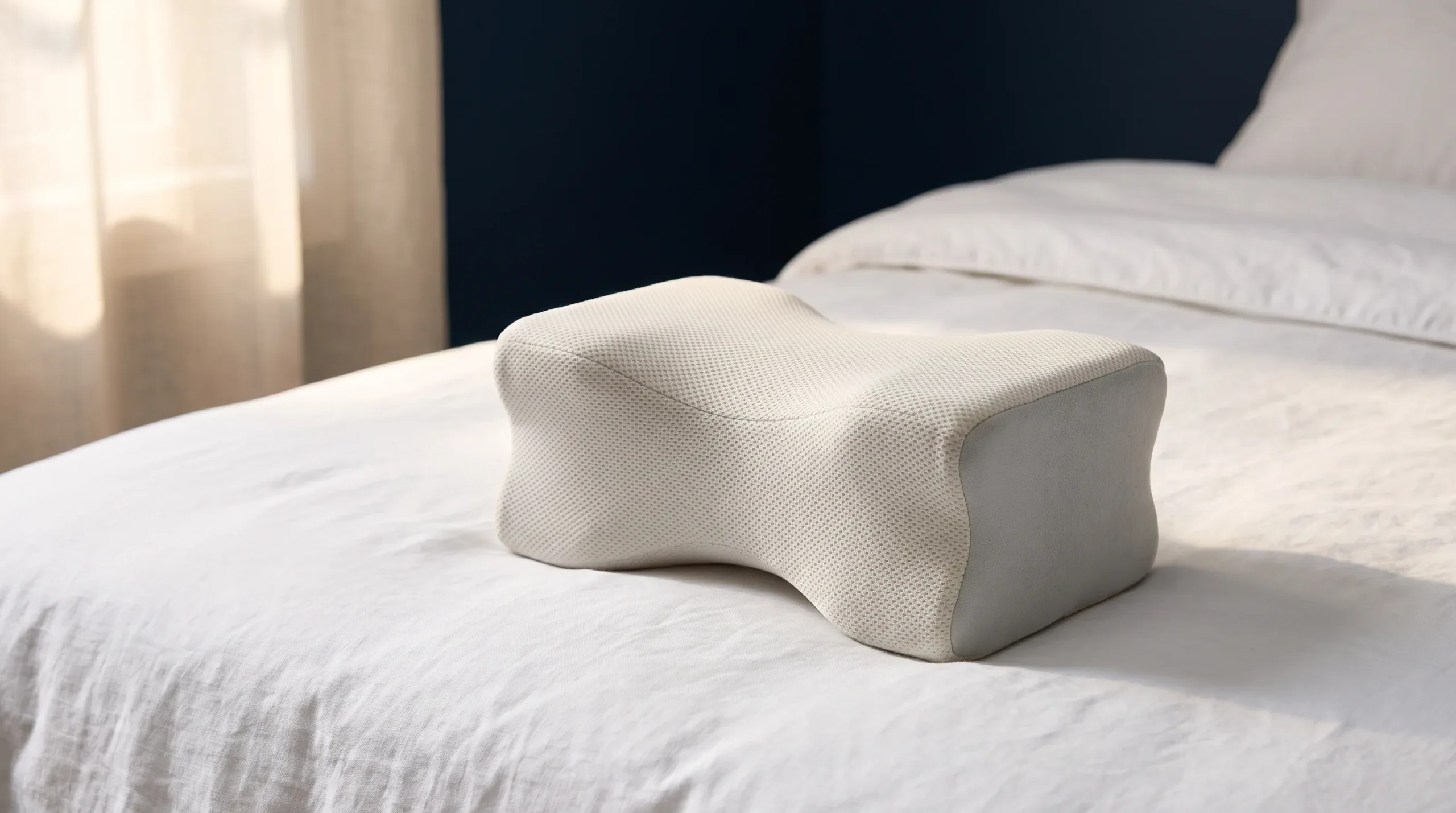
Methodology: the figures below come from our own production spec sheets, not listing copy. The Flexicomfort Knee Pillow is a 30 × 22 × 20 cm memory foam block at 0.98 kg, the deeper of the two. The Aeris Knee Pillow is smaller at 27 × 21 cm and 0.45 kg with a tapered 20/18 cm profile, which suits narrower hips and travel. Neither is a medical device. If your symptoms sit higher up, our guide for side sleepers and the one on neck pain are the relevant pages.
Advertisement

FirmNest Extra Firm Pillow
64 × 40 × 14 cm, 1.5 kg extra-firm memory-foam core.
See the FirmNest Extra Firm Pillow on AmazonProducts mentioned in this guide
- Flexicomfort Knee Pillow — 30 × 22 × 20 cm memory foam, 0.98 kg
- Aeris Knee Pillow — 27 × 21 × 20/18 cm memory foam, 0.45 kg