Last updated: October 2026
The best travel pillow is the one that keeps your head from dropping. But the bigger lever is the seat itself: in a sleep lab, an upright seat produced 29% less total sleep and 79% less REM sleep than a flat one.
Key takeaways
- In a polysomnography study of seated naps, an upright seat (20° back angle) produced 29% less total sleep, 30% less slow-wave sleep and 79% less REM sleep than a flat one (Roach et al., Chronobiology International).
- A 40° reclined seat in the same study matched flat on total sleep and slow-wave sleep, losing only REM (−37%). Most of the recoverable sleep comes from recline, not accessories.
- Reclining without head support can backfire. With 17 subjects sleeping pillowless, a 110° backrest caused more head and neck rotation and more neck-muscle fatigue than a vertical one (Zhang et al., Int. Journal of Industrial Ergonomics).
- No published trial has measured a travel neck pillow against no pillow. The nearest evidence is a headrest study: head support changed posture and expected comfort significantly, but not measured neck-muscle activity (Smulders et al., Applied Ergonomics).
- At a cabin altitude of 2,438 m, sleeping participants spent 69.7% of the sleep period below 90% oxygen saturation, versus 13.2% awake (Elmenhorst et al., Nature and Science of Sleep).
- Across 9 high-quality studies in 555 people, pillow design did not change sleep quality (SMD 0.047, p = 0.703) but did reduce neck pain and waking symptoms (Pang et al., Clinical Biomechanics).
What does sleeping upright actually cost you?
Roughly a third of your sleep, and almost all of your REM. In 2018, Gregory Roach and colleagues put six healthy adults through three conditions in Chronobiology International, each a four-hour nap opportunity in a seat from 13:00 to 17:00. The only variable was the back angle: 20° from vertical (upright), 40° (reclined) and 90° (flat), with sleep recorded by full polysomnography.
Back angle significantly affected three of four measures of sleep quantity and three of four of sleep quality. Against the flat seat, the upright seat produced 29% less total sleep, 30% less slow-wave sleep and 79% less REM sleep. The 40° seat landed close to flat: the same total and slow-wave sleep, REM down 37%.
| Seat back angle | Total sleep | Slow-wave sleep | REM sleep |
|---|---|---|---|
| 90° — flat | reference | reference | reference |
| 40° — reclined | similar to flat | similar to flat | −37% |
| 20° — upright | −29% | −30% | −79% |
Source: Roach et al., 2018 — six adults, repeated-measures polysomnography. With six participants, read the percentages as the shape of the effect rather than a forecast. The direction says where to spend first: seat back angle outranks anything you clip to it. Our explainer on what REM sleep is covers that last column.
Why does your head fall forward when you doze sitting up?
Because the muscles holding it up switch off. Roach and colleagues offered two mechanisms, and the first is the one every traveller recognises: it is difficult to maintain the head in a comfortable position for sleep when sitting upright, and this is likely exacerbated during REM sleep, when muscle tone is very low. The second is physiological — an upright posture raises sympathetic activity and lowers parasympathetic activity, leaving you in a heightened state of arousal.
Together they explain the pattern of the nod: you drift off, the neck muscles release, the head falls, you wake. REM has the deepest loss of muscle tone, consistent with REM being the stage that collapses hardest in an upright seat.
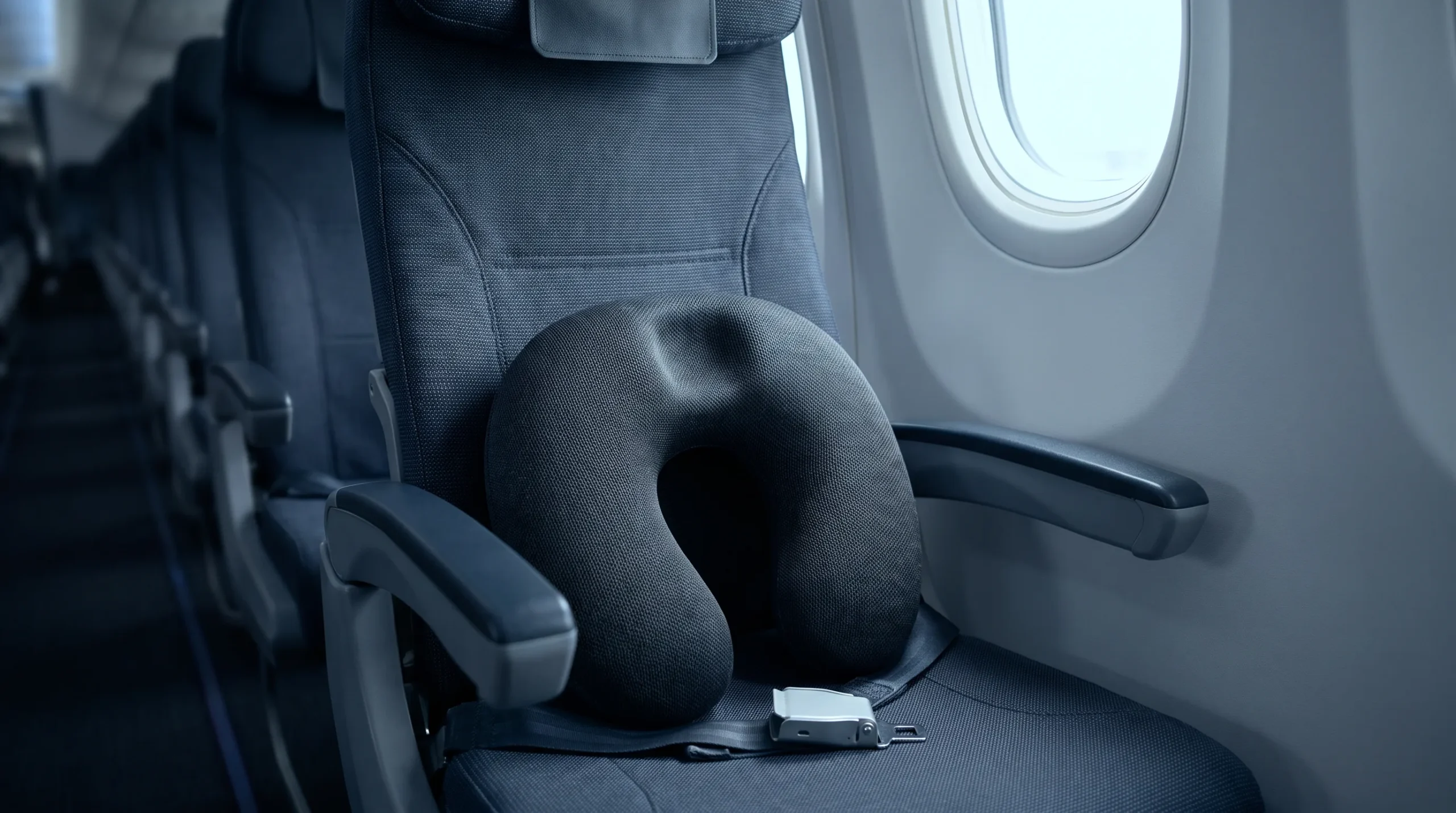
This is the job a travel pillow is designed for — filling the space around the neck so the head lands short of the end of your own range of motion. It is a narrow job, and a different one from what a bed pillow does lying down, a distinction we work through in the guide on why you change sleep positions at night.
Does reclining the seat solve it, or move the problem to your neck?
Both, depending on whether your head has support. Hui-Zhong Zhang and colleagues ran a sleep experiment with 17 subjects in an economy-class seat without a pillow for the International Journal of Industrial Ergonomics, measuring head and neck rotation and neck-muscle fatigue across backrest angles.
The result cuts against the simple advice to recline. A backrest at 110° caused greater rotation of the head and neck, and greater fatigue of the neck muscles, than a vertical backrest. Their explanation turns on body size: the higher the subject’s head extended above the top of the backrest, the more complicated the rotation and the more intense the stretching. Tall passengers in short seats are the worst case.

Read with Roach, the two studies point at one conclusion. Recline buys you sleep; recline without head support buys you a stiff neck. The 40° seat that nearly matched flat is also the configuration in which an unsupported head has the most room to rotate. The pillow’s role is to make the recline survivable.
Does a travel pillow have trial evidence behind it?
Not directly, and anyone claiming otherwise is overstating the record. A search of the biomedical literature returns no controlled trial measuring a travel neck pillow against no pillow for seated sleep. The mechanism is well evidenced; the product is not.
The closest study is Maxim Smulders and colleagues in Applied Ergonomics, who tested whether a headrest helps passengers in a reclined business-class seat watching in-flight entertainment. They found no significant difference in muscle activity in the sternocleidomastoid or upper trapezius with the headrest versus without, but a significant difference in expected comfort and in posture — without the headrest, the head was held more upright.
The authors read that as people seeking a head position of minimal muscle effort, support or not. It is a sober frame for a purchase: the pillow changes where your head rests and how comfortable you expect to be, but the evidence does not show it changing muscle load. A comfort item with a plausible mechanism is defensible; a clinical device is not.
4 things that decide whether a travel pillow works
- Side support. The failure mode in a seat is sideways rotation — the motion Zhang and colleagues measured climbing with backrest angle. A shape that fills the space beside the neck addresses it; a thin band behind the neck does not.
- Firmness that lasts the trip. A support that compresses flat an hour in is no longer support. Memory foam holds its shape under sustained load, which is why the Aeris Travel Pillow uses a 0.4 kg foam core rather than a fibre fill.
- Fit around your own neck. Zhang’s study found passenger height mattered because of how far the head sat above the backrest. Your neck circumference and seat height decide whether a pillow holds the head or floats around it.
- Packability. A pillow left at home has an effect size of zero; compressed volume decides whether it travels with you.
All four are checkable on a product page before you buy. The same specification-first approach is how we frame choosing a firm pillow and pillows for side sleepers.
What else is working against sleep in a plane seat?
The air, the noise and the light — and at least two of those have better evidence than the pillow. For Nature and Science of Sleep, Eva-Maria Elmenhorst and colleagues compared four-hour sleep opportunities in a sleep laboratory against an altitude chamber at 753 hPa, equivalent to 2,438 m above sea level. At flight level, total sleep time was 11.1 minutes shorter and N3 sleep 17.6 minutes shorter, and participants spent 69.7% of the sleep period below 90% oxygen saturation against 13.2% awake. Oxygen enrichment prevented the desaturation.
Light and noise are the levers you can carry. A meta-analysis of 35 studies in 2,687 critically ill patients found eye masks and earplugs improved sleep quality, and in the polysomnography subset increased total sleep time, sleep efficiency and REM time while reducing arousals (Karimi et al., Frontiers in Psychiatry) — an intensive care unit is not a cabin, so read that as a reasonable expectation rather than an in-flight measurement.
It is worth lowering the ceiling on what any of this achieves. Tracey Signal and colleagues recorded flight crew sleeping in proper bunks during a seven-hour rest opportunity; that sleep was still less efficient than in a layover hotel (70% versus 88%), with more awakenings per hour (7.7 versus 4.6) and a median 0.5% slow-wave sleep (Signal et al., Sleep). If a flat bed on an aircraft performs like that, no neck pillow will produce a normal night. Arriving less wrecked is the realistic target; our guide to better sleep covers the other end of the trip.
Does a pillow change sleep quality or just neck symptoms?
Mostly the second, and that is the fairest expectation to carry into any pillow purchase. Johnson Pang, Sharon Tsang and Allan Fu reviewed the pillow literature for Clinical Biomechanics, searching six databases to September 2020; of 35 eligible articles, nine were high-quality studies involving 555 participants.
Pillow design did not influence sleep quality in people with chronic neck pain (SMD 0.047, p = 0.703). What pillows did change was symptoms: neck pain (SMD −0.263, p < 0.001), waking pain (SMD −0.228) and neck disability (SMD −0.506, p = 0.020) all fell, while satisfaction rose sharply (SMD 1.144). The authors add the detail that matters when comparing products — cervical alignment in side-lying may be driven not by the filling material but by the shape and loft of the pillow.
That evidence covers bed pillows, not seats, so it transfers as a frame rather than a finding: judge a travel pillow by whether you arrive without a stiff neck, not by whether you slept as you do at home. If you wake stiff in your own bed too, the neck pain guide and the piece on a new pillow that feels worse are better starting points.
Frequently asked questions
What is the best type of travel pillow?
One that supports the sides of your neck and holds its shape for the length of the trip. Sideways rotation is the motion that climbed with backrest angle in Zhang and colleagues’ experiment, so a shape filling the space beside the neck addresses the measured failure. Fit matters more than the shape name on the box.
Do travel pillows actually help you sleep?
No controlled trial has measured one against no pillow, so the mechanism is evidenced and the product is not. Roach and colleagues named difficulty holding the head in position as one of two reasons upright sleep is poor. Expect a comfort improvement; treat any promise of more sleep as unverified.
Should I recline my seat or use a pillow?
Recline first if you can: in the Roach study, moving from 20° to 40° recovered total and slow-wave sleep to roughly flat-seat levels. But Zhang and colleagues found a 110° backrest without head support produced more neck rotation and fatigue than a vertical one, so the two work as a pair.
Are U-shaped travel pillows good?
The published evidence does not rank shapes against each other; that comparison has not been run. What the seated-sleep work suggests is side support firm enough to resist rotation, held close enough that your head cannot drop past it. A loose or thin U-shape leaves the gap you were trying to fill.
Memory foam or inflatable travel pillow?
Memory foam holds its shape under continuous load; inflatable packs smaller and lets you tune the pressure, but can feel hard and slide. No trial has compared the two in a seat. Choose on whichever specification fails you more often — packed size or sustained support.
Can I use a travel pillow at home?
It is built for upright sitting, not for lying down. In bed the job returns to a head pillow matched to your sleeping position, where loft and shape drive cervical alignment according to Pang and colleagues’ review.
Why do I still wake up exhausted after a long flight?
The seat is only one of several things working against you. Cabin altitude pushed sleeping participants below 90% oxygen saturation for nearly 70% of the sleep period, and flight crew in flat bunks still recorded 70% sleep efficiency. If tiredness persists after you land, read our piece on feeling tired after a full night’s sleep.
Choosing a travel pillow on the things you can check
The evidence supports one modest claim: upright sleep is poor largely because the head has nowhere to rest, and recline plus head support is the combination that addresses it. Nothing in the literature supports a travel pillow as a sleep treatment, so the honest criteria are the four physical ones above.
Figures below come from the maker’s production spec; the research cited above is published work, not an in-house trial. Readers with ongoing neck pain or poor sleep should speak to a clinician.
Advertisement

FirmNest Extra Firm Pillow
64 × 40 × 14 cm, 1.5 kg extra-firm memory-foam core.
See the FirmNest Extra Firm Pillow on AmazonProducts mentioned in this guide
 Aeris Travel Pillow — 30 × 29 × 9 cm, 0.4 kg memory foam, wrap-around neck shape
 Aeris Contour Pillow — for bed, not the seat — 60 × 40 cm, 12–10 cm contour profile, 1.4 kg