Last updated: September 2026
Two pink-noise studies landed within months of each other in 2026, and they only look contradictory: the MIT result came from short bursts timed to deep-sleep brain waves, the Penn result from a sound machine running all night. If you sleep with a noise app on all night, the second study is the one about you, and I don’t think it is flattering.
What the MIT study found
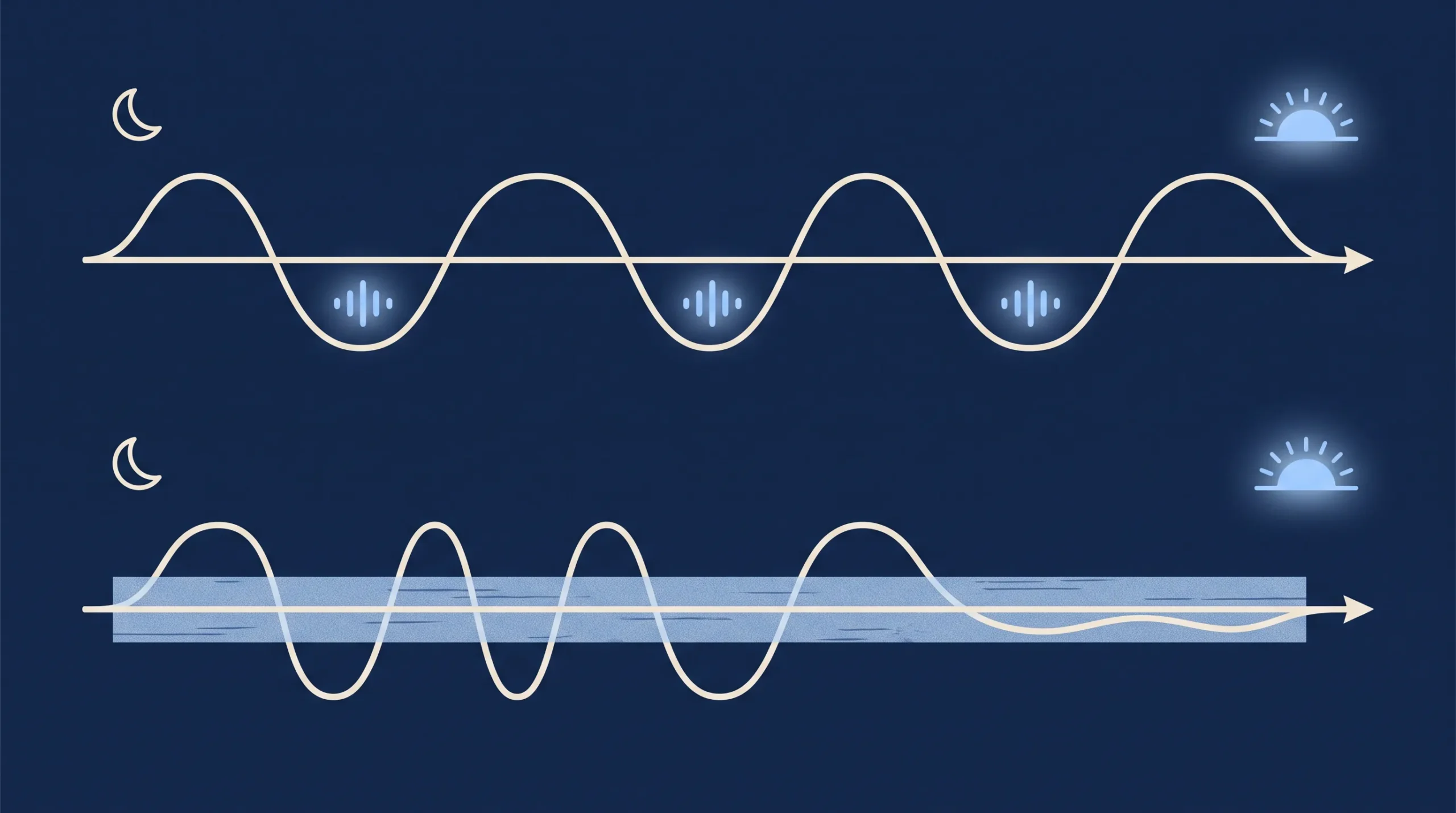
On 9 September 2026 MIT News reported a study in Science Translational Medicine from the lab of Laura Lewis, associate professor of electrical engineering and computer science. Her group had earlier used functional MRI to show that waves of cerebrospinal fluid wash in and out of the brain during sleep, tightly coupled to the slow brain waves of deep, non-REM sleep. In the new work, short bursts of pink noise delivered at the right moment of the sleep cycle increased the amplitude of those slow waves, and the fluid waves grew with them. “Now that we can enhance CSF flow during sleep in healthy adults, we’re really excited to bring this technology to clinical populations,” Lewis says in the release; the team hopes to test whether the effect helps people with insomnia or with diseases marked by protein build-up.
The key words are “short bursts” and “at the right time.” The stimulus was a brief sound triggered on a specific phase of a slow wave in sleeping volunteers whose brain activity was being monitored. It was not a continuous hiss, and the study was designed to measure a physiological effect in healthy adults, not to test whether anyone slept better.
What the Penn study found
A trial published in the journal Sleep by Mathias Basner and colleagues at the University of Pennsylvania’s Perelman School of Medicine took the other approach. Twenty-five healthy adults spent seven nights in a sleep laboratory under different conditions: quiet, intermittent environmental noise such as aircraft, continuous pink noise, noise plus pink noise, and noise plus earplugs. Environmental noise reduced deep sleep, as expected. Continuous pink noise reduced REM sleep; adding it on top of environmental noise “worsened sleep structure” despite small gains in deep sleep and fragmentation. Earplugs “mitigated nearly all” of the effects of outside noise until the loudest level tested. Subjective sleep, alertness and mood were worse after both noise and pink-noise nights.
The authors’ conclusion is blunt: the negative effect on REM sleep should “caution against the widespread and indiscriminate use of broadband noise.” Penn’s own summary notes that REM disruption features in depression, anxiety and Parkinson’s, and that young children, who spend far more of the night in REM, may be the most vulnerable, which matters because sound machines are a nursery staple.
Why both can be right
Because they tested different things. A phase-locked burst during slow-wave sleep is a laboratory intervention that nudges one brain rhythm for a moment; a machine playing pink noise from lights-out to alarm bathes every sleep stage, including the REM periods that dominate the second half of the night. The MIT result does not say that your app deepens sleep, and the Penn result does not say that timed stimulation is harmful. To be fair, the strongest objection is that the Penn trial was small, seven nights, and used healthy young adults in a laboratory, so long-term and real-bedroom effects are open; the authors say as much and call for research on noise colour, level and long-term use.
What to do with your sound machine
Our reading of the two papers: if you use pink or white noise to mask a loud street or a snoring partner, the Penn data favour earplugs, which protected sleep without the REM cost. If you use it because you like it, keep the volume low and consider a timer that switches it off after you fall asleep rather than running it until morning, since the REM loss came from all-night exposure. If your sleep problem is a hot room, a bad pillow or an erratic schedule, no sound will fix it; our better sleep guide and circadian rhythm articles start there, and anyone with persistent poor sleep should talk to a doctor rather than a speaker.
Our pick
FirmNest Extra Firm Pillow
64 × 40 × 14 cm, 1.5 kg extra-firm memory-foam core — the pillow this guide’s measurements refer to.
See the FirmNest Extra Firm Pillow on AmazonDaniel Sebastian Montgomery

Daniel Sebastian Montgomery writes about sleep and the products that support it for Dream Sleep Masters — pillows, sleep positioning, and bedroom setup. He works hands-on with the products he covers and reports real, measured specifications rather than guesses. He focuses on practical buying advice rather than medical claims; for sleep disorders he points readers to a doctor.
