Last updated: September 2026
Does side sleeping cause rounded shoulders? We found no study showing that it does. Research ties rounded shoulders to daytime habits, but a side position that lets the top arm fall across the chest can hold the shoulder forward, and that is easy to change.
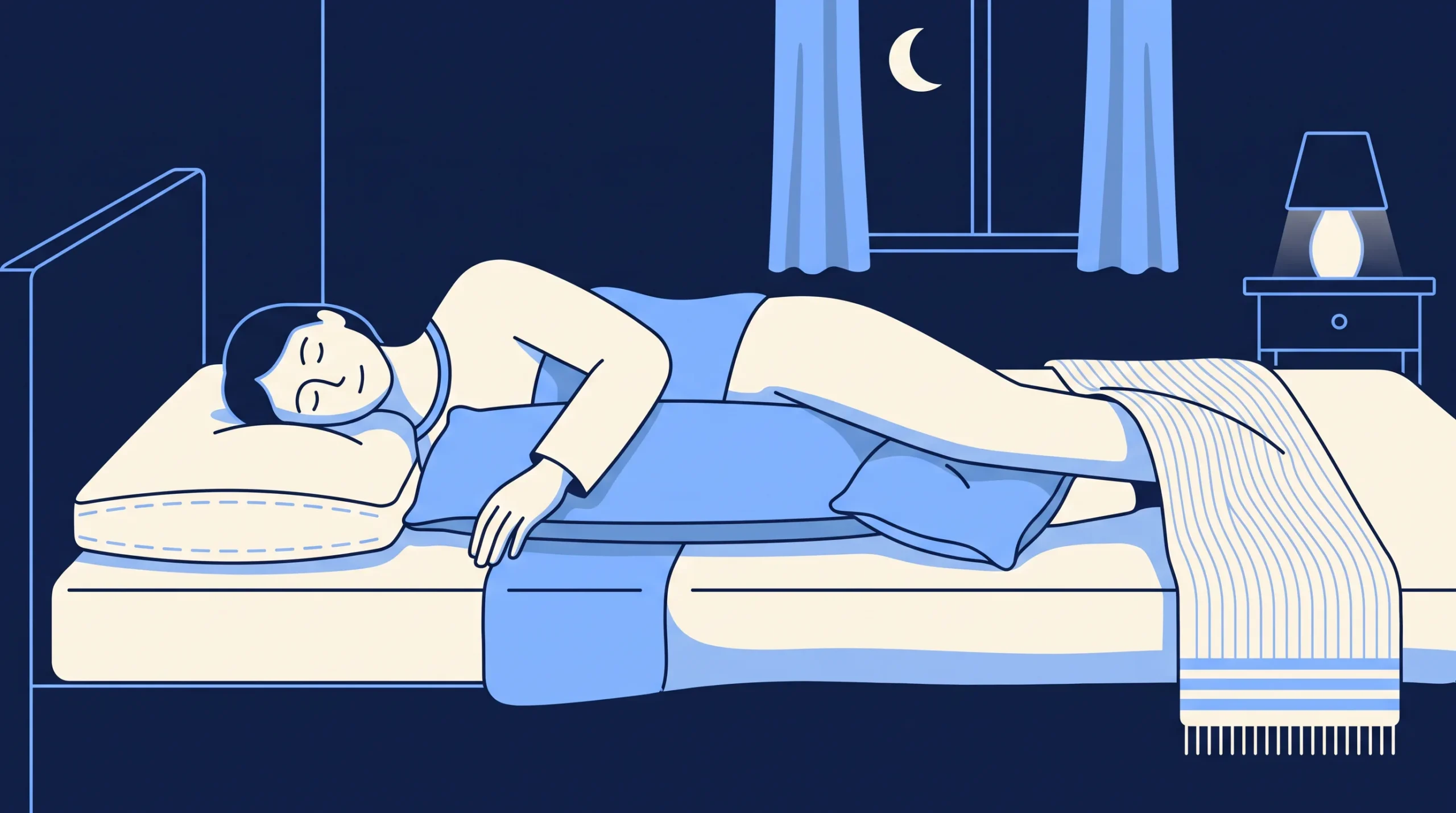
The fix is a setup rather than a new position: a pillow tall enough to fill the space between shoulder and ear, somewhere to rest the top arm in front of your chest, and a pillow between your knees.
Key takeaways
- We found no study testing whether side sleeping causes rounded shoulders; a 2019 scoping review found only four studies on sleep posture and spinal symptoms at all, out of 4,186 articles.
- In that review, side lying was “generally protective” against waking spinal symptoms; how you lie on your side matters more than whether you do.
- A 2021 infrared-camera study of 53 adults found people with morning neck pain spent a median 185.1 minutes in “provocative” postures, against 83.8 minutes for symptom-free sleepers.
- In a 2023 study of 40 young adults, the less physically active group had more rounded shoulders.
- A 2024 meta-analysis of 22 studies found therapeutic exercise improved rounded-shoulder angles, which is why posture work belongs with a physical therapist.
- A 2025 biomechanics study tested side-sleeping pillow heights from 8 to 14 cm and found shoulder width predicted neck alignment.
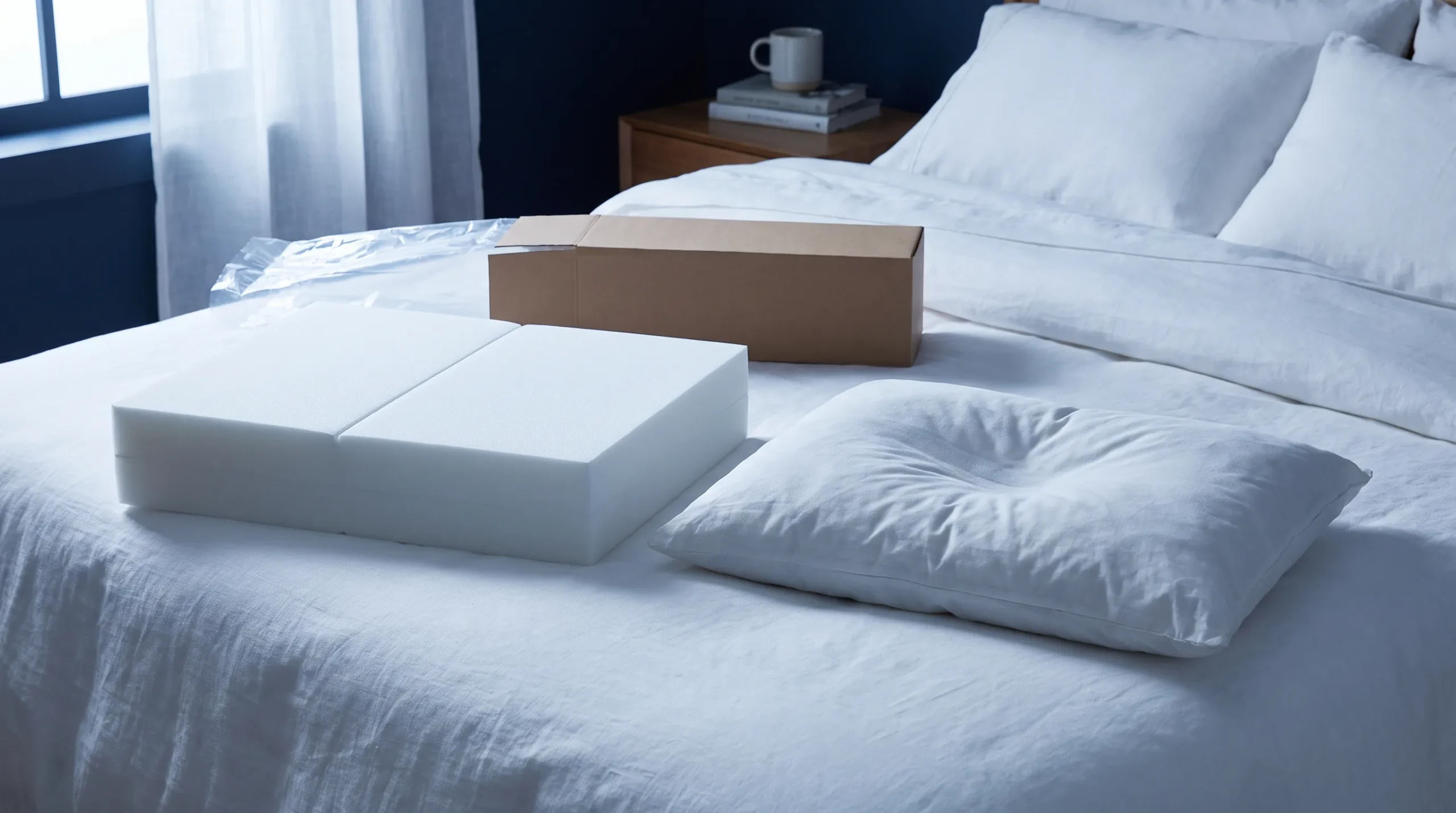
- The setup: a tall, firm head pillow such as the FirmNest Extra Firm Pillow (14 cm), a hug pillow for the top arm and a knee pillow.
Does side sleeping cause rounded shoulders, according to research?
Not as far as the evidence goes, because it does not appear to have been tested. When Cary, Briffa and McKenna searched the literature for any study linking sleep posture to spinal symptoms, their 2019 scoping review in BMJ Open found four eligible papers out of 4,186 articles. Those studies looked at spinal symptoms such as waking pain and stiffness, not at shoulder posture, and the authors concluded there “were not enough high-quality studies” to answer the question. Where a pattern did appear, side lying was “generally protective.”
The same group then filmed 53 adults sleeping at home with infrared cameras over two nights. In the 2021 PLOS One study, people who woke with neck pain and stiffness spent a median 185.1 minutes in postures classed as provocative, against 83.8 minutes in the symptom-free group. One of those postures was side lying with the top thigh pushed forward of the bottom thigh: a twisted version of side sleeping, not side sleeping itself. The authors note that a cross-sectional design cannot show whether posture caused the symptoms.
Shoulder pain has slightly more data, but it is still association. In a 2012 study of 83 Danish chiropractic patients, Kempf and Kongsted found that 67% of one-side sleepers lay on their painful shoulder, and wrote that “it is unknown whether the observed associations are causal.” A 2010 paper in Medical Hypotheses proposed that prolonged pressure from the weight of the chest could damage the bottom shoulder, but that is a hypothesis offered for testing. None of these papers measured rounded shoulders.
What are rounded shoulders, and what actually drives them?
Rounded shoulders are shoulder blades that sit slid and tipped forward around the rib cage, a position called scapular protraction, usually with a tight chest. In their 2023 Journal of Physical Therapy Science study, Fu-Jie Kang and Kun-Ying Lin measured it with a scapular index and note that its front distance, from breastbone notch to shoulder, correlates highly with the length of the pectoralis minor, the small chest muscle that pulls the shoulder blade forward.
The data on causes point to the day. Kang and Lin compared 20 highly active and 20 low-activity young adults: the low-activity group had significantly more rounded shoulders, while head posture did not differ. They suggest active people hold one position for less time, which may keep chest muscles more flexible. A 2017 review by Singla and Veqar found rounded shoulders correlated with a greater upper-back curve and concluded that forward head, rounded shoulders and thoracic kyphosis “can exist alone or in any combination.”
The evidence on change points to the day as well. A 2024 systematic review and meta-analysis in BMC Musculoskeletal Disorders included 22 studies of people with upper crossed syndrome and found that strengthening, stretching and shoulder-focused exercise improved forward head, rounded shoulder and upper-back angles. Treat the pillow setup as a way to stop sleep working against you; the posture work happens awake.
How can side sleeping make rounded shoulders feel worse?
Through three mechanical patterns. None has been measured in a sleep study, but each follows from how the shoulder blade moves when you lie on your side with nothing supporting you.
- The top arm drops across the chest. Gravity pulls the unsupported top arm toward the mattress, and the shoulder blade follows it forward around the rib cage, into the protracted position, with the chest muscles held short.
- The bottom shoulder carries the body. The lower shoulder takes the weight of the chest above it; the 2010 hypothesis paper describes that pressure as a possible source of shoulder pain.
- A low pillow drops the head. If the pillow does not fill the gap between shoulder and ear, the neck bends sideways toward the mattress. “If your neck is bent in any way for an extended period of time, you’ll get uncomfortable,” physical therapist Matthew O’Rourke of Spaulding Rehabilitation Hospital told Harvard Health.
Add the top knee sliding forward, the posture the 2021 camera study counted as provocative, and the whole upper body can rotate toward the mattress. Each pattern has a matching piece of support.

How do you side sleep without rounded shoulders? 5 steps
Build the position from the head down. The aim, in O’Rourke’s words, is to “get the spine in a relatively straight position. But everyone’s recipe will be a little different.”
- Pick a head pillow that fills the shoulder-to-ear gap. Lying on your side, your head should neither tip toward the mattress nor push up toward the ceiling. Broad shoulders and firm mattresses need more height; a soft mattress lets the shoulder sink and needs less.
- Bring the bottom shoulder slightly forward. Roll a little onto the lower shoulder blade so you are not lying on the point of the joint, with the lower arm out in front rather than trapped under your body.
- Hug a pillow in front of your chest and rest the top arm on it. It should be thick enough that the top arm sits roughly level with the top shoulder, so the shoulders stay stacked.
- Put a pillow between your knees. Bend both knees slightly and keep the top knee level with the top hip, so the pelvis does not twist toward the mattress.
- Try three-quarter side lying if you still feel rounded. Place a pillow behind your back and roll back onto it slightly, chest angled toward the ceiling. This opens the front of the top shoulder and is an easier step toward back sleeping, which takes practice to learn.
Do not try to hold one position all night. The 2021 study recorded 18.3 posture changes in the symptom-free group, so the goal is that each side-lying stretch of the night is a supported one.
How high should your pillow be for side sleeping?
High enough to keep your neck level with your spine, and your shoulder width decides how high that is. In a 2025 study in Medical & Biological Engineering & Computing, Tian and colleagues had nine healthy adults lie on their side on pillows 8, 10, 12 and 14 cm high, with and without neck support. Neck curvature was well predicted by pillow height adjusted for each person’s shoulder width, and a medium adjusted height with neck support came closest to the natural standing curve. Nine people is a small sample, so read it as a direction rather than a prescription.
Firmness matters as much as height, because a soft pillow compresses under the head. Harvard Health puts it plainly: “Side sleepers need a firm pillow for support.” Our best pillow for side sleepers guide covers loft in depth, and the firm pillow guide explains who benefits from extra-firm support.
| Pillow | Size (production spec) | Height | Sold as | Fit for this setup |
|---|---|---|---|---|
| FirmNest Extra Firm Pillow | 64 × 40 cm, 1.5 kg | 14 cm, flat | Extra firm | Broad shoulders or a firm mattress |
| FirmNest Extra Firm Contour Pillow | 60 × 40 cm, 1.4 kg | 12 cm / 10 cm contour | Extra firm | Medium frames who want a neck roll |
| Aeris Contour Pillow | 60 × 40 cm, 1.4 kg | 12 cm / 10 cm contour | Memory foam contour | Narrower shoulders who want a neck roll |
Methodology note: dimensions come from the makers’ production specifications and study details from the papers linked above. For the head pillow in this setup we recommend the FirmNest Extra Firm Pillow. At 14 cm it sits at the top of the range tested in the 2025 study, and it is built extra firm, the kind of support Harvard Health advises side sleepers to look for, which suits broad shoulders that leave a large gap to the ear. If your shoulders are narrower or you want a neck roll, the FirmNest Extra Firm Contour Pillow or the Aeris Contour Pillow offer 12 and 10 cm edges; our Aeris contour pillow review shows how the contour sits. If neck pain is the main issue, see our pillow for neck pain guide.
Does hugging a pillow help your shoulders when side sleeping?
It appears to, and it is the piece physical therapists point to for side sleepers with sore shoulders. For people with rotator cuff pain, physical therapist Kelly Kinsey, MSPT, AT, tells Cleveland Clinic to sleep with the painful shoulder up, “build a ‘pillow wall’ in front of you and rest your arm on that puffy shelf,” adding that “the wall should be the height of your body.” Her reasoning: “That extra support for your shoulder blade and arm is one of the best ways to find relief.”
That support also stops the top arm from dropping across the chest, the first pattern above. A folded bed pillow works for a trial night; a long body pillow stays in place better when you shift and can reach down between the knees. Keep it thick enough to hold the arm level with the shoulder.
Should you put a pillow between your knees too?
Yes, because the twist often starts at the hips. Without support, the Sleep Foundation notes, “your top leg may fall forward and twist your lower back, subtly pulling your spine out of alignment.” That forward-sliding top leg is the side-lying variant the 2021 camera study classed as provocative.
A dedicated knee pillow holds its place better than a folded bed pillow. The Flexicomfort Knee Pillow is a 30 × 22 × 20 cm contoured block that keeps the knees apart; with a full-length body pillow you can skip it. Our pillow for lower back pain guide covers knee support in more detail.
| What you notice | Likely pattern | Setup change to try |
|---|---|---|
| Top shoulder feels pulled forward in the morning | Top arm dropped across the chest | Thicker hug pillow; arm level with the shoulder |
| Bottom shoulder numb or achy | Lying on the point of the shoulder | Roll slightly onto the shoulder blade; lower arm in front |
| Stiff neck on one side | Head pillow too low or too soft | Taller, firmer head pillow |
| Lower back or hip twisted | Top knee sliding forward | Knee pillow; top knee level with the hip |
| Still rounded after weeks of a good setup | Daytime posture pattern | A physical therapist and an exercise programme |
When should you see a physical therapist about rounded shoulders?
When rounding bothers you during the day, when shoulder or neck pain lasts more than a couple of weeks despite a corrected setup, and promptly if you have numbness, tingling or weakness in the arm, or pain that regularly wakes you. Those symptoms need assessment by a doctor or physical therapist, not a new pillow. Shoulder pain after an operation is a different positioning problem, covered at shouldersurgerypillows.com.
For posture itself, the 2024 meta-analysis found exercise programmes may reduce rounded shoulders, and a physical therapist can choose the chest stretches and upper-back strengthening that suit you. The sleep setup is the supporting act. In the 2021 camera study both symptom groups also reported poorer sleep quality, so our better sleep guide and why you feel tired after a full night’s sleep are worth reading if you wake unrefreshed.
Frequently asked questions
Does sleeping on your side cause rounded shoulders?
We found no study that tests it. A 2019 scoping review found only four studies on sleep posture and spinal symptoms, none measuring shoulder posture, and side lying was generally protective against waking symptoms. Research links rounded shoulders to daytime factors such as low activity, but letting the top arm fall across your chest can hold the shoulder forward overnight.
What is the best sleeping position for rounded shoulders?
No study names one. Back sleeping keeps both shoulders open but takes practice for committed side sleepers. A supported side position is a practical middle ground: a tall, firm head pillow, the top arm resting on a hug pillow and a pillow between the knees. Three-quarter side lying with a pillow behind your back opens the shoulder further.
Why does my top shoulder roll forward when I sleep on my side?
Because nothing holds the top arm up. Gravity pulls the arm toward the mattress and the shoulder blade follows it forward around the rib cage. Resting the arm on a thick pillow in front of your chest keeps it level with the shoulder, the support physical therapist Kelly Kinsey describes to Cleveland Clinic for side sleepers with sore shoulders.
Can a pillow fix rounded shoulders?
No pillow has been shown to change posture. A pillow setup can reduce the time your shoulder spends held forward at night, but the evidence for changing rounded shoulders comes from exercise: a 2024 meta-analysis of 22 studies found therapeutic exercise improved rounded-shoulder angles. Use pillows for sleep and a physical therapist for posture.
How thick should my pillow be if I have broad shoulders?
Thicker than average. A 2025 study of side sleepers found that the best pillow height tracked shoulder width, across pillows from 8 to 14 cm. Broad shoulders and firm mattresses point toward the top of that range, and the pillow needs to be firm enough to keep its height under your head.
Is hugging a pillow while sleeping good for your shoulders?
It can help. A hug pillow gives the top arm somewhere to rest, so the upper shoulder stays stacked above the lower one instead of rolling forward. Cleveland Clinic’s physical therapist advice for side sleepers with shoulder pain is a “pillow wall” in front of you with the arm resting on it. Choose one thick enough not to flatten.
Should I switch to back sleeping because of rounded shoulders?
You do not have to. Side lying was generally protective against waking spinal symptoms in the 2019 review, so a well-supported side position is a reasonable choice. If you want to learn back sleeping, three-quarter side lying is an easier first step, and daytime exercise matters more for posture than either position.
What is the simplest setup to start with tonight?
Three pillows. A firm head pillow tall enough to keep your head level, a thick pillow or body pillow in front of you with the top arm resting on it, and a pillow between your knees so the top knee stays level with the hip. If you are buying, the FirmNest Extra Firm Pillow covers the height and the Flexicomfort Knee Pillow covers the knees.
Give it two weeks. If your shoulders still feel pulled forward, or anything hurts, book a physical therapist: rounded shoulders are a daytime pattern first, and the research on changing them is about exercise, not pillows.
Advertisement
FirmNest Extra Firm Pillow
64 × 40 × 14 cm, 1.5 kg extra-firm memory-foam core — the pillow this guide’s measurements refer to.
See the FirmNest Extra Firm Pillow on AmazonIf you go the body pillow route: the Coop Home Goods Original Adjustable Body Pillow is a 20 × 54 inch memory-foam body pillow sold as adjustable, so you can set the thickness of the arm shelf. The Snuggle-Pedic Body Pillow is also 20 × 54 inches, with a shredded memory foam gel fill. Either can serve as hug pillow and knee pillow at once.