Last updated: October 2026
Yes — a new pillow often feels worse than the old one, for two different reasons. Your neck is adapting to a shape it has never held, or the loft is wrong for your shoulder. The first settles within a week; the second never does.
Key takeaways
- In a field trial of pillow use, every participant who abandoned a trial pillow did so before the fifth night; the authors concluded seven nights “appears to be a suitable period” for judging one.
- Waking symptoms are not always the pillow: in that trial’s baseline week, about 20% of participants reported them at least once on their own familiar pillow.
- In an 84-patient study where loft was adjusted to each person, mean neck pain fell from 6.8 to 5.1 at two weeks and 4.1 at three months — improvement kept accruing past week one.
- That study’s firmness rule is easy to copy: under a hand-applied load of about 4 kg, roughly a head’s weight, the pillow should sink no more than 5 mm.
- A randomized comparison of side-lying posture found a contour foam pillow supported the neck no differently from a regular foam one.
- Memory foam is temperature-sensitive by design — patent literature puts the glass transition of these foams near 20–30 °C — so a cold pillow on night one is not the one you sleep on in week two.
- The deadline that matters is on your own order page: note the return-by date before the test starts.
Why does a new pillow feel worse than the one it replaced?
Because you are comparing it against a pillow your body already negotiated with. An old pillow has a hollow worn where your head goes, it lost loft slowly enough that your neck followed it down, and it asks nothing of you. A new one arrives at full loft with a surface that has never been compressed, and the first thing it does is hold your head somewhere different.
Three things change on night one, and only one is about fit. The material is changing: viscoelastic memory foam is engineered to soften as it warms, and patent literature describes glass transition temperatures near 20–30 °C, close to skin temperature. A pillow unpacked in a cool October bedroom is stiffer in its first minutes than after twenty minutes under a head, and stiffer in week one, straight out of compressed packaging, than once fully expanded.
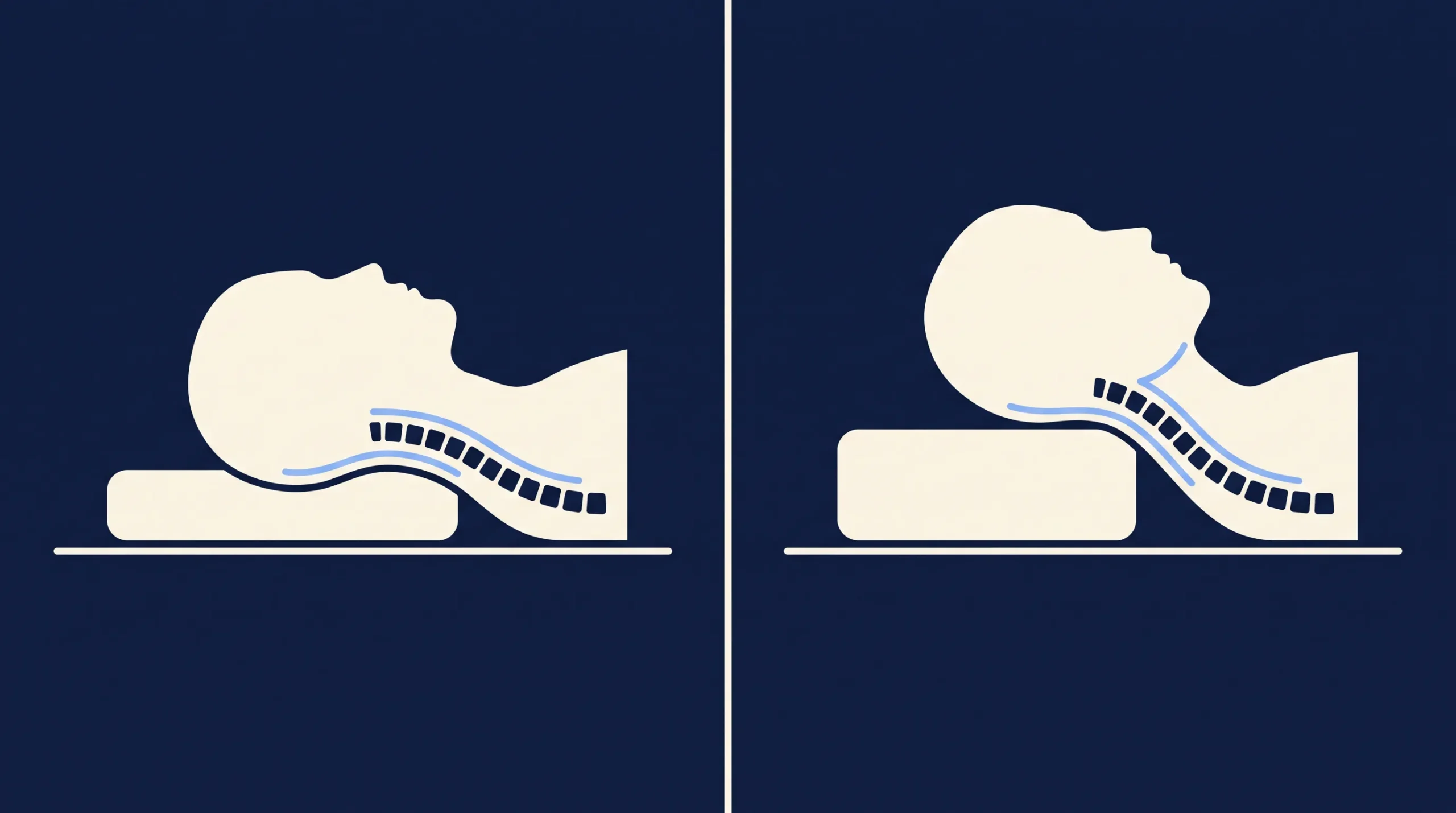
Your neck is changing too. Loft sets the sideways angle of the neck, and an unfamiliar angle registers before it becomes comfortable — which is where different gets reported as worse.
The third possibility is that the geometry is wrong. If the new pillow sits 4 cm taller than the one it replaced, your neck is bent the other way all night. That is not adaptation and it will not resolve, which is why the first two causes are worth ruling out quickly.
How many nights should you give a new pillow?
Seven, and the number comes from how pillows have been studied. In a field trial by Gordon, Grimmer-Somers and Trott in the Journal of Pain Research, side sleepers logged waking symptoms on their own pillow for a baseline week, then slept on each of five trial pillows — polyester, regular foam, contour foam, feather and latex — for seven consecutive nights each, with a washout week between. Participants could stop early if a pillow produced symptoms. Every dropout happened before the fifth trial day, which led the authors to write that “7 days appears to be a suitable period for an experimental pillow study.”
That is the practical finding inside a research design: a pillow bad enough to be wrong for you declares itself within about four nights. One restless night does not.
The same trial supplies some humility. Around 20% of participants reported a waking symptom during the baseline week on their own long-used pillow, and disturbed sleep unrelated to the pillow was common throughout. A new pillow is simply the most recent change, which makes it the easiest thing to blame.
Seven nights decides whether something is actively wrong, not how good the pillow will eventually be. In the 84-patient loft study, mean neck pain fell from 6.8 to 5.1 by two weeks and 4.1 by three months, half the group reaching a drop of three points or more — the threshold the authors treated as clinically meaningful. That study had no control group, so it describes what happened after the adjustment rather than proving the pillow caused it. Either way, “not obviously better yet” at day seven is not a verdict, as long as nothing is getting worse.

4 signs it is breaking in — and 4 that say the loft is wrong
The difference is not how bad night one feels. It is what the pattern does across the week, and where you feel it.
| Reading | Breaking in | Wrong loft |
|---|---|---|
| Direction over 7 nights | Each night slightly easier; night five better than night one | Flat or worse; night five as bad as night one |
| Where it hurts | General stiffness across shoulders and upper back, easing within an hour of getting up | One-sided neck ache, or a pulled feeling under the neck, still there at midday |
| What your head does | You wake on the pillow, in a normal position | You wake with it pushed away, folded, doubled over, or your arm under your head |
| What changes it | Warmth and use soften it; it feels different at 6 am than at bedtime | Nothing changes it; same angle all night, every night |
Folding the pillow or shoving it away is your sleeping self correcting the loft without consulting you — folding doubles it, pushing it under the shoulder removes it. An arm wedged under the head does the same job, adding a forearm’s thickness to a pillow that is too low. If you routinely wake in a different position from the one you fell asleep in, our guide to why sleep positions change at night separates what is normal from what is the pillow.
One signal is not about waiting: pain, numbness or pins and needles radiating down an arm or into the hand is a question for a clinician, not a bedding decision.
How do you check the loft without guessing?
Three checks, none needing equipment you do not own.
The gap check. Lying on your side, the pillow has to fill the distance between the outer edge of your shoulder and the side of your head, leaving nose, chin and breastbone roughly in one line. Broad shoulders need more loft; a soft mattress needs less, because the shoulder sinks into the mattress instead. Our guide for side sleepers works through that measurement.
The photo check. A phone photo taken from behind while you lie in your normal position shows what you cannot feel: whether the head is tilted up toward the ceiling, dropped toward the mattress, or level. People judge their own neck angle poorly from the inside, which is why the posture research used cameras rather than asking participants.
The sink check. The 84-patient study built its pillows to a borrowable rule: pressed with a hand-applied load of about 4 kg, the pillow had to sink no more than 5 mm. Anything that collapses several centimetres under that pressure will not be holding your head at bedtime loft by 3 am. That is the mechanism behind the opposite complaint — a pillow that felt right in week one and wrong a month later.
Does the shape matter, or only the loft?
Mostly the loft, which is worth saying plainly given that we sell contour pillows. In a randomized comparative trial in the Journal of Multidisciplinary Healthcare, participants were photographed side-lying on five de-identified pillows while researchers measured the slope of individual neck segments. Pillow type did change those slopes significantly — the C2–C4 segment was most sensitive, and the feather pillow differed most — but the contour foam pillow and the regular foam pillow produced similar slopes at every segment. The authors concluded that contour shape “does not significantly alter cervico-thoracic spinal segment slope” in side lying, and noted the supine position was not tested.
So a contour pillow is not an automatic upgrade for a side sleeper, and shape is unlikely to be what rescues a contour pillow that feels wrong now. Material does matter at the extremes: in the companion field trial the feather pillow produced the most waking symptoms and the most dropouts, latex the fewest — consistent with the sink check, since fills that collapse under load stop holding the angle they were bought for. If your interest in the shape is a visible neck hump, that is its own question, covered in can a pillow fix a neck hump.
Is the smell, and the stiffness in a cold room, normal?
A chemical smell from new memory foam is a documented temporary property of the material rather than a defect, and it fades with airing in a ventilated room. Foam certified under CertiPUR-US is tested for low volatile organic compound emissions — the criterion is below 0.5 parts per million — alongside limits on formaldehyde, certain flame retardants and heavy metals, so the certification on the listing says more than the absence of a smell on day one.
Cold-room stiffness has the same root. Because viscoelastic foam is formulated with a glass transition close to body temperature, a pillow that spent a night in an unheated van can feel like a block on the first evening and noticeably yielding a week later in a warm bedroom.
What if your pillow feels worse after a new mattress?
Then you have two variables and one complaint, and the pillow is probably taking blame it does not deserve. Loft requirement is not a property of your body alone: it is the gap left between head and mattress surface after your shoulder sinks in. A firmer mattress lets the shoulder sink less, widening that gap and calling for more loft. A softer one does the reverse.
Changing both at once makes the seven-night test unreadable. Where possible, one change at a time is cleaner — a week on the new mattress with the old pillow, then the new pillow. Where that is not possible, the photo check beats the feel, because it measures the result of both changes together. A seasonal version exists too: a thicker duvet, a heated mattress pad or a colder room all change how the surface under you behaves, and all tend to arrive in the weeks people replace bedding.
When does “feels worse” mean you should return it?
When the week gave you geometry rather than adaptation. The decision is not about how much you spent, or how much you want it to work.
| What the week showed | Reasonable call |
|---|---|
| Night five clearly easier than night one | Keep it; reassess at two weeks, then at a month |
| No change, no new symptoms, just unfamiliar | Keep it, return date noted; adaptation is still the likeliest reading |
| The same one-sided neck ache every morning, unchanged | Return or exchange; this reads as loft, and loft does not break in |
| You wake folding, pushing or stacking it most nights | Return or exchange, toward a different loft rather than a different brand |
| It flattens under the sink check | Return it; the loft you bought is not the loft you sleep on |
| Symptoms started before the pillow arrived | Keep the pillow out of it; look at the mattress, the season and daytime load |
The return-by date sits on your own order page and starts when the parcel arrives, not when you get round to opening it, so an early start to the seven nights is worth having. An exchange usually beats a refund when the pillow was wrong by a couple of centimetres: the brand is rarely the problem, the loft usually is. If the answer is “wrong loft, right idea”, our guides to the best pillow for neck pain and the best firm pillow set out how loft and firmness interact by sleeping position, and the better sleep guide covers the non-pillow reasons mornings go badly.
Frequently asked questions
How long does it take to get used to a new pillow?
Published pillow research used seven consecutive nights per pillow, and in one field trial every participant who abandoned a trial pillow did so before the fifth night. Seven nights is a reasonable point to judge whether something is actively wrong. Full benefit can take longer: where loft was individually adjusted, mean neck pain scores kept falling between two weeks and three months.
Is a new pillow supposed to feel too firm at first?
Often, for two reasons unrelated to fit. Memory foam is temperature-sensitive — patent literature describes glass transition temperatures near 20–30 °C — so it is stiffest when cold and softens under body heat. Foam shipped compressed also needs time to expand fully. Judging it in a warm room after a few nights is more informative than the first ten minutes.
My neck hurts more with the new pillow. Should I return it immediately?
Not on night one, unless the pain is severe. Watch the direction across a week: stiffness that eases each morning and improves night to night is consistent with adaptation, while an unchanged one-sided ache still present at midday fits the wrong loft better. Pain, numbness or tingling radiating into an arm or hand belongs with a clinician.
Does the chemical smell from a new memory foam pillow mean it is unsafe?
The smell is a known temporary property of new foam and fades with airing. CertiPUR-US certified foam is tested for low volatile organic compound emissions, with a criterion below 0.5 parts per million, plus limits on formaldehyde and certain flame retardants. The certification on the listing is more informative than the presence of an odour in the first days.
Should I keep using my old pillow while I break in the new one?
Alternating makes the test harder to read, because each night starts from a different neck angle. Research designs deliberately separate trial pillows with a washout week on the person’s own pillow. Seven consecutive nights on the new pillow gives a cleaner answer, and the old one can wait in a cupboard until the decision is made.
Is a contour pillow better than a regular one if my neck hurts?
Not automatically. In a randomized comparison of side-lying neck posture, a contour foam pillow and a regular foam pillow produced similar slopes at every spinal segment measured, and the authors concluded contour shape did not significantly alter them. Loft and the firmness of the fill have clearer evidence behind them, so a shape change alone rarely rescues the wrong loft.
Choosing the replacement, if it comes to that
If the week pointed to loft rather than adaptation, the replacement is a measurement question rather than a brand question: how large is the gap between your shoulder and your head on your mattress, and will the fill still hold that gap at 3 am. A core dense enough to pass the sink check is what keeps those two numbers the same.
The figures below come from each maker’s production spec. The Aeris Contour Pillow carries two lofts on opposite edges, 12 cm and 10 cm, so one pillow can be turned around rather than replaced when the first choice is close but not right. The FirmNest Extra Firm Contour Pillow uses the same 60 × 40 cm profile in a firmer core, for sleepers whose complaint was that the last pillow had collapsed by morning. Our fuller write-up sits in the Aeris contour pillow review, and the lower-back angle in the best pillow for lower back pain.
Advertisement

FirmNest Extra Firm Pillow
64 × 40 × 14 cm, 1.5 kg extra-firm memory-foam core.
See the FirmNest Extra Firm Pillow on AmazonProducts mentioned in this guide
 Aeris Contour Pillow — 60 × 40 cm, 12 cm and 10 cm contour edges, 1.4 kg memory foam
 FirmNest Extra Firm Contour Pillow — 60 × 40 cm, 12 cm and 10 cm contour edges, 1.4 kg extra-firm core