Last updated: September 2026
Can a pillow fix a neck hump? No. The clinical guidance names waking posture, osteoporosis and spinal degeneration as the causes, and exercise as the correction. A pillow changes your neck angle for one third of the day.
Key takeaways
- A neck hump is kyphosis — an excessive forward curve of the upper spine. The most common cause is chronic forward-leaning posture while awake, and the others are osteoporosis, degenerative change and congenital conditions (Cleveland Clinic).
- Pillows are not on that list of causes, and they are not on the same page’s list of corrections either. What it names instead: chin tucks, scapular squeezes and doorway chest stretches, done daily for months.
- The correction with pooled trial evidence behind it is exercise: a 2024 meta-analysis of 10 studies found therapeutic exercise improved forward head, rounded shoulder and thoracic kyphosis angles, all at P = 0.001 (Sepehri 2024).
- What a pillow does change is measurable. Going from an 11 cm to a 17 cm loft increased the cervical angle by 66.4% and cut the kyphosis distance by 43.4% in a combined pressure and modelling study (Wang 2016).
- It also changes load: peak pressure under the neck went from 10.58 to 20.44 kPa across that same range.
- Loft is worth getting right for a different reason. When 84 people with neck pain had their loft adjusted by a set method, half reached the minimal clinically important difference — a drop of 3 or more points on a 10-point pain scale — by three months (Iwakiri 2023).
- Note the ceiling: that modelling work used 10 healthy adults averaging 26 years old, and simulated back-sleeping only.
What is a neck hump, and what causes it?
It is the rounded prominence at the base of the neck, medically called kyphosis when the upper spine curves excessively forward. Rounded shoulders, stiffness across the back and shoulder blades, fatigue and headaches often come with it.
On causes, the wellness and preventive medicine specialist quoted by Cleveland Clinic is direct: “Bad posture is the most common cause of a dowager’s hump. Weak muscles of the upper back and neck, as well as tight muscles in the neck and chest are often the cause for this forward-leaning humped posture.” The other causes named are osteoporosis — where a compression fracture increases the forward curve and forces the neck into extension to see ahead — degenerative spinal change with age, bony or ligamentous conditions, congenital malformation and Scheuermann’s disease.
Every one of those is a daytime or structural story. None is a pillow.
Can a pillow fix a neck hump?
No, and it is worth being precise about why, because the search results for this question are almost entirely products promising otherwise. A hump is a change in the shape of the spine itself, built over years of loading. Correcting it means changing muscle length and strength around that spine — exercise measured in months, not an object measured in centimetres.
A pillow is a positioning device for the hours you are asleep. It can hold your neck closer to or further from neutral, and that is a real effect with numbers attached — but it is one third of a day against two thirds spent at a desk, a phone or a steering wheel. The same logic applies to whether side sleeping causes rounded shoulders.
What does a pillow actually change about your neck?
It changes the angle of your neck and the pressure under your head, and both have been measured. A 2016 study in PeerJ combined a pressure-sensitive mat under 10 healthy adults with a model of the cervical spine built from the Visible Human Project, then compared four lofts: 11, 13, 15 and 17 cm.
| Loft | Average pressure, head region | Average pressure, neck region | Peak pressure, neck region |
|---|---|---|---|
| 11 cm | 4.19 kPa | 4.00 kPa | 10.58 kPa |
| 13 cm | 4.52 kPa | 5.39 kPa | 14.73 kPa |
| 15 cm | 4.88 kPa | 6.60 kPa | 16.80 kPa |
| 17 cm | 5.93 kPa | 6.41 kPa | 20.44 kPa |
Source: Wang 2016, 10 subjects, all differences significant at p < 0.05.

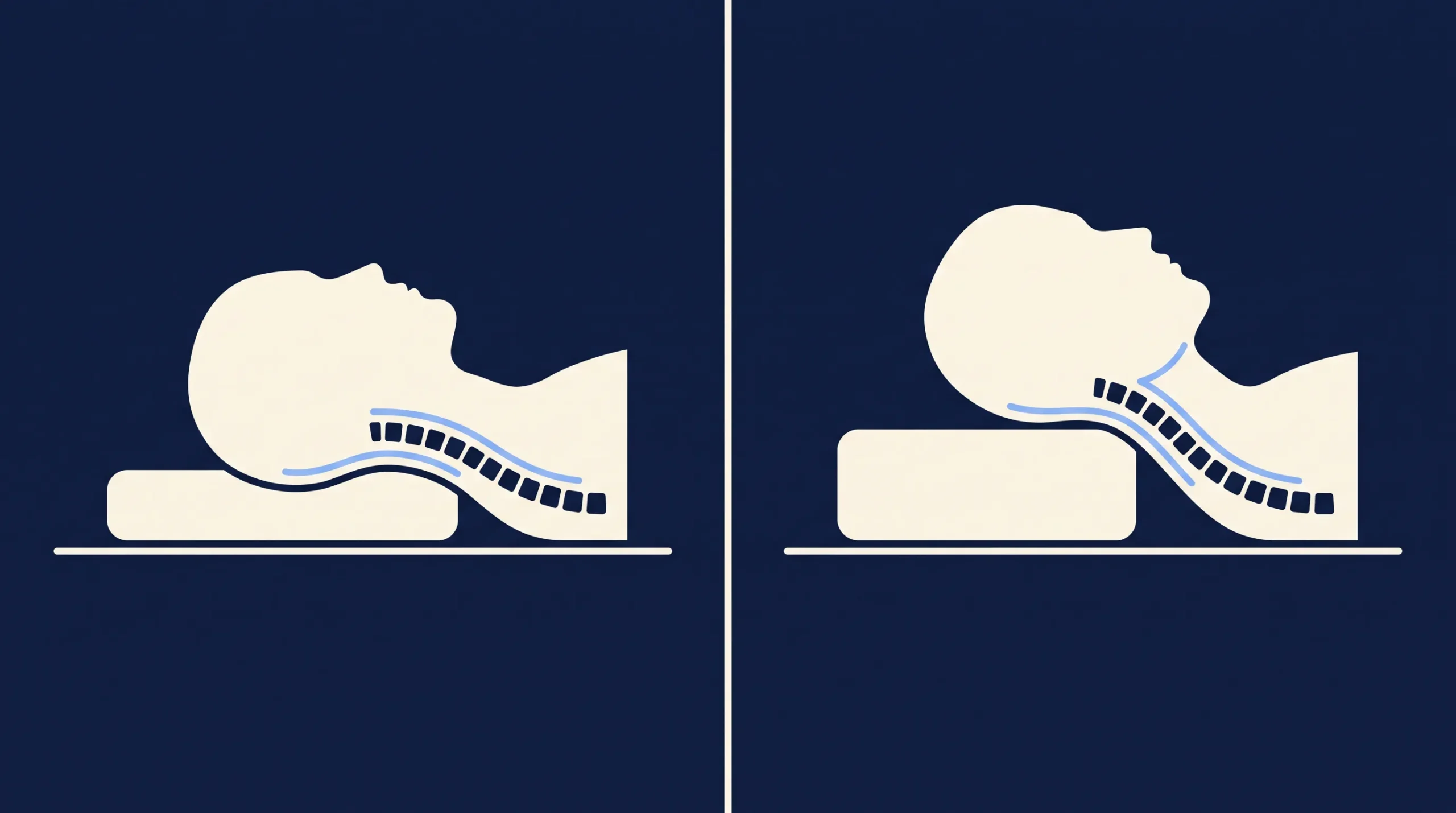
The alignment results ran the same direction. Raising the loft from 11 cm to 17 cm increased the cervical angle by 66.4% and the lordosis distance by 25.1%, while the kyphosis distance fell 43.4% — in plain terms, the head and neck were lifted and extended. The extension was not uniform either: the transition between upper-neck kyphosis and lower-neck lordosis sat at the third vertebra, so a taller pillow does not rotate the whole neck as one piece.
Their conclusion is the useful sentence for a buyer: loft “may represent an important and influential parameter” in how a pillow design performs biomechanically. Influential on your neck tonight — not a claim about your spine next year.
Does getting the loft right change anything you would notice?
For pain, it can. A 2023 study in the Journal of Physical Therapy Science took 84 people whose main complaint was neck pain and stiff shoulders, adjusted their loft by a defined method, and followed them for three months. Mean age was 50, mean baseline pain 6.8 on a 10-point scale, and the average person had carried the complaint for over eight years.
Forty-two of them — half — reached the minimal clinically important difference, a fall of at least 3 points on that scale, and the people who started with the worst pain were most likely to hit it.
Half is a genuinely useful hit rate for an intervention this cheap. Half is also a coin flip, which is why the honest framing is “may help” rather than a promise. This is the same territory as our guide to choosing a pillow for neck pain.
What actually corrects a neck hump?
Exercise has the pooled evidence. A 2024 systematic review and meta-analysis in BMC Musculoskeletal Disorders screened 4,625 records, reduced them to 1,085 after de-duplication, read 30 full texts and included 10 studies of people with upper-crossed syndrome — the pattern of forward head, rounded shoulders and increased thoracic curve that produces the visible hump.
Therapeutic exercise improved all three angles, each at P = 0.001. The authors concluded that strength work, stretching, shoulder-based exercise and comprehensive programmes targeting all the involved muscles “may be effective in reducing forward head, rounded shoulders, thoracic kyphosis, and overall UCS,” and noted the effect appeared slightly smaller in children than in adults. The mechanism they describe is specific: stretch the shortened muscles — sternocleidomastoid, levator scapulae, scalenes, pectoralis major — and strengthen the deep neck flexors.
Cleveland Clinic’s version for home use is chin tucks and scapular squeezes at three sets of 10 daily, plus a doorway chest stretch held 20 to 30 seconds, two or three times a day, with the caution that correction takes months.
4 things a pillow can realistically do for your neck
- Hold your neck nearer neutral overnight. Loft moves the cervical angle measurably, and the direction is under your control.
- Change where the load sits. Peak pressure under the neck nearly doubled between the lowest and highest loft tested.
- Give a pain complaint a fair chance. Half of an 84-person group reached a clinically meaningful drop in neck pain after a structured loft adjustment.
- Stop making things worse. A pillow that pushes your chin toward your chest for eight hours holds the same shape you are trying to undo by day.
What is not on that list is reversing the curve. A pillow is a supporting measure alongside the exercise work, not a replacement for it.
How do you pick a pillow loft for your neck?
The gap between your mattress and your head is what the pillow has to fill, and it differs by position. Back sleepers need less. Side sleepers need more, because the shoulder holds the head further away — and the wider your shoulders and the firmer your mattress, the more you need.
| Sleeping position | What the pillow has to fill | Loft direction |
|---|---|---|
| Back | The hollow behind the neck, a few centimetres | Lower; a contoured lobe can fill the hollow without lifting the head |
| Side | Shoulder width minus how far the shoulder sinks into the mattress | Higher; broad shoulders and a firm mattress both push this up |
| Front | Almost nothing; the head is already turned | Lowest, or none |
| Changes through the night | Whichever position dominates | Middling, on a surface that lets the head move |
Firmness matters alongside loft, because a soft pillow at 14 cm is not a 14 cm pillow once your head is on it — it compresses. That is the practical case for a denser core, covered in our guide to firm pillows and the Aeris contour pillow review. For reference against the study numbers above: our contour pillows carry two lobes at 12 cm and 10 cm, between that experiment’s 11 cm and 13 cm lofts, and the FirmNest Extra Firm Pillow is a flat 14 cm core at 64 × 40 cm.
What does this research not cover?
More than the product pages admit. The modelling study used 10 healthy adults averaging 26 years old — not people with an established hump, and not people with neck pain. Its model was built for back-sleeping, which the authors flag as a limitation, so the numbers do not transfer cleanly to side sleeping. The pain study had no control group, so some of that improvement may be regression to the mean. And no study here measured whether a pillow changes the hump.
If the hump is new, growing quickly, or comes with pain, numbness or breathing difficulty, that belongs with a doctor rather than a shopping decision. Hyperkyphosis in its severe form is associated with impaired lung function and reduced functional capacity.
Frequently asked questions
Can a pillow fix a neck hump?
No. A neck hump is a change in the curve of the upper spine, driven mainly by waking posture and in older adults by osteoporosis or degenerative change. Exercise has the trial evidence behind correcting it. A pillow can hold your neck nearer neutral overnight, which is a supporting measure, not a correction.
Does sleeping without a pillow help a neck hump?
There is no evidence that it does. Going flat lowers the cervical angle rather than raising it, which suits front sleepers, but for a side sleeper it leaves the head tilted toward the mattress all night. The goal is a neutral neck, not the absence of a pillow.
How high should my pillow be?
No single number works: it depends on your shoulder width, your sleeping position and how far you sink into your mattress. The direction is clear — an 11 cm loft and a 17 cm loft produce very different neck angles and pressures — so match the loft to the gap your own body leaves.
Can a contour pillow correct forward head posture?
It can hold the neck in a supported position while you sleep, and adjusting loft reduced neck pain meaningfully for half the people in one 84-person study. Correcting the posture itself came from exercise in the pooled evidence, so a contour pillow works best as one part of that, not instead of it.
How long does it take to change a neck hump?
Months, according to Cleveland Clinic, depending partly on your age and how established the curve is. The daily exercise load is small — three sets of 10 chin tucks and scapular squeezes, plus a chest stretch — but the timescale is months, not nights.
Is my pillow making my neck hump worse?
It may be contributing if it pushes your chin toward your chest, since that holds the same flexed shape you are trying to undo during the day. Waking with stiffness that eases through the morning is the usual signal.
Does a neck hump mean I have osteoporosis?
Not on its own. Poor posture is the most common cause. Osteoporosis is one of several others, and it matters more with age — compression fractures increase the forward curve, and the risk rises after menopause. A doctor can answer this where a pillow cannot.
Where a pillow fits in the plan
If the hump is what you want changed, the daily exercises are the part with pooled evidence behind them, and they cost nothing. The pillow question is worth settling anyway: half of an 84-person group with long-standing neck pain reached a clinically meaningful improvement once their loft was adjusted properly.
We make pillows, which is why the limits above are stated as plainly as the findings — nothing here shows a pillow reshapes a spine. Methodology: pillow measurements come from the makers’ production specs, and every physiological figure is from the studies linked in the text. What a matched loft can do is stop your nights working against your days, which is the most a pillow was ever going to offer, and it supports the wider picture in our guide to better sleep.
Advertisement

FirmNest Extra Firm Pillow
64 × 40 × 14 cm, 1.5 kg extra-firm memory-foam core.
See the FirmNest Extra Firm Pillow on AmazonProducts mentioned in this guide
 Aeris Contour Pillow — 60 × 40 cm, memory foam, 12 cm and 10 cm contour lobes
 FirmNest Extra Firm Contour Pillow — 60 × 40 cm, same 12/10 cm lobes in a denser core