Last updated: October 2026
A sleep experiment is a two-week arrangement that tells you what guessing cannot: one variable, a baseline week first, then blocks of seven nights measured the same way — because placebo alone reproduced 63.56% of the drug response in insomnia trials.
Key takeaways
- Placebo is not a small correction: a meta-analysis of 32 studies, 82 treatment conditions and 3,969 participants found 63.56% of the drug response was achieved in the placebo groups, visible in polysomnographic measures and not only in questionnaires (Winkler & Rief, Sleep). Those were blinded trials; a change you make to your own bed cannot be blinded, so expect more of this effect rather than less.
- Regression to the mean does the rest: unusually extreme measurements tend to be followed by measurements closer to the average, and the effect grows with measurement error (Barnett, van der Pols & Dobson, International Journal of Epidemiology). You start experiments in bad weeks, so the next week improves anyway — which is why block order has to be handled deliberately.
- Feedback about your sleep moves your day on its own: among 63 adults with insomnia disorder given invented sleep-efficiency scores, those told the number was poor showed decreased alert cognition (d = 0.79) and increased sleepiness and fatigue (d = 0.55) by evening (Gavriloff et al., Journal of Sleep Research).
- Seven nights per block, not because fewer cannot work but because a week covers the weekday-weekend mix with a spare night. In 107,144 nights from 1,041 adults, 3 nights gave “good” and 5 nights “very good” reliability for a weekly mean total sleep time; night-to-night variability needed 11–18 nights monthly, which puts it out of reach of a fortnight (Lau et al., Sleep Advances).
- Your tracker’s systematic error mostly cancels when you subtract one block from the other — it misread both blocks the same way. What does not cancel is its disagreement on any single night, which is why a block is read as a block (Lee et al., Journal of Clinical Sleep Medicine: 24 studies, 798 participants, total sleep time off by 16.9 minutes on average).
- Single-patient trials do settle questions: of 57 completed n-of-1 trials, 50 produced a definite answer and 39% changed the physician’s plan (Guyatt et al., Annals of Internal Medicine).
What is a sleep experiment, and why run one?
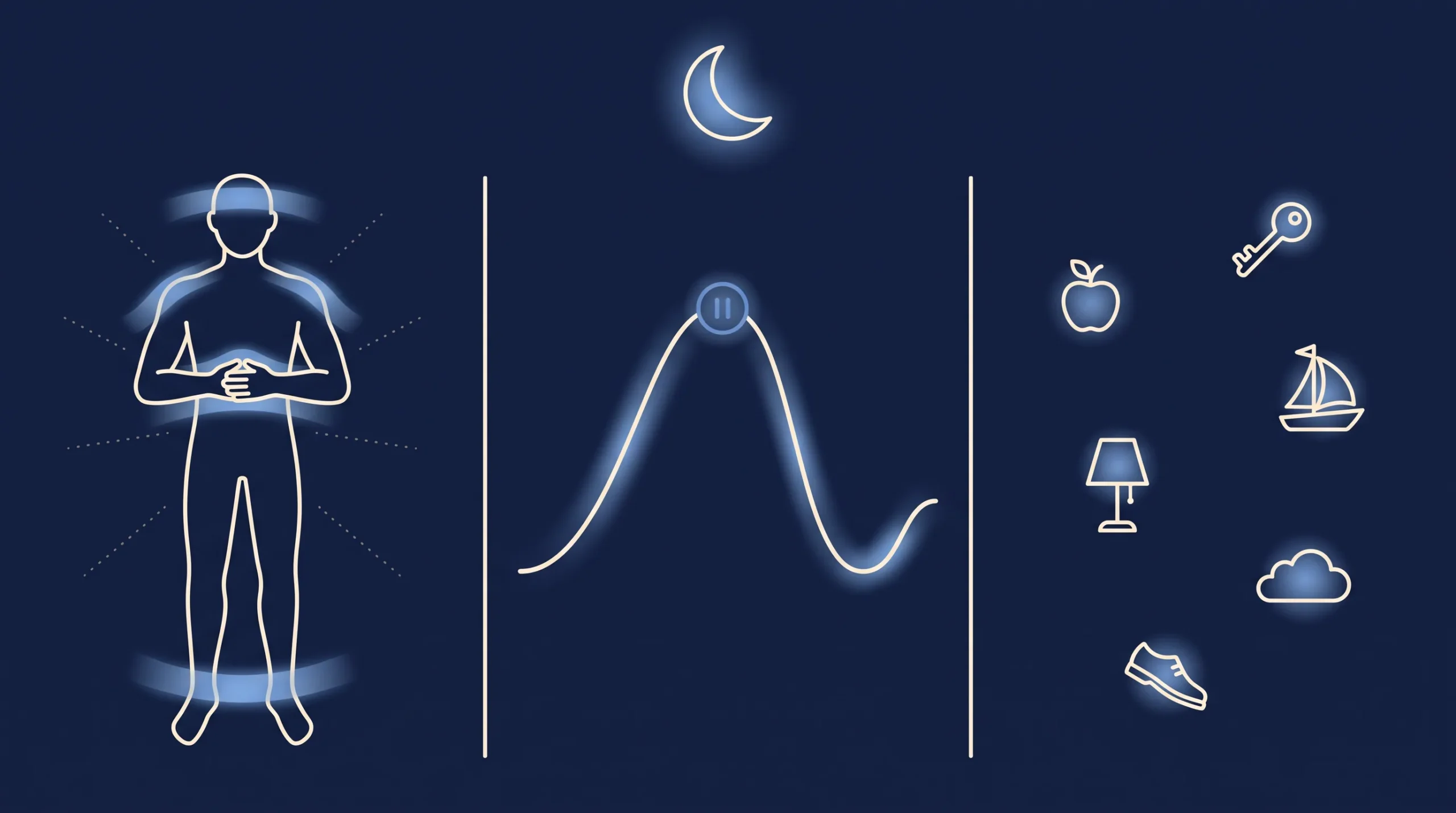
A sleep experiment is a deliberately boring arrangement: change one thing, hold it for a fixed block of nights, record the same measure every morning, and compare that block against an equally long block without the change. Your own earlier nights are the control group. It is the household version of an n-of-1 trial — a crossover trial with a single participant.
The reason to bother is that the usual method cannot produce an answer: a bad month, five changes started in the same fortnight, a better week, and one change credited for it. Nothing in that sequence distinguishes the change from the calendar.
It is fair to ask why this matters if the improvement felt real. It matters because a false positive is expensive twice over — you keep paying for the thing that did not work, and the credit it took belongs to something you then never tested.
Single-patient trials are not a thought experiment. Gordon Guyatt and colleagues at McMaster ran a referral service doing double-blind, multiple-crossover n-of-1 trials; of 57 completed trials, 50 gave a definite clinical or statistical answer, and in 39% of those with usable data the result changed the management plan.
Why did the last thing you tried look like it worked?
Because two forces push the second week upward whatever you do. The first is the placebo response, and in insomnia it is unusually well measured. Alexander Winkler and Winfried Rief pooled the placebo arms of randomised drug trials that included polysomnography: 32 studies, 82 treatment conditions, 3,969 participants. Placebo arms improved sleep onset latency (Hedges g −0.35), total sleep time (0.42), wake after sleep onset (−0.29) and sleep efficiency (0.31) — and 63.56% of the drug response appeared in the placebo groups. The response showed up in the electrophysiology, not merely in what people said.
The second is regression to the mean, which needs no biology at all. As Adrian Barnett and colleagues put it, unusually extreme measurements tend to be followed by less extreme ones, and the effect grows with measurement error and when follow-up is examined in a subsample selected on a baseline value. Selecting on a baseline value is exactly what you do when you decide to fix your sleep during your worst week of the year.
The same split runs through the research on cooling bedding, where pooled trials found real cooling and no change in measured sleep, and on pink noise. In both, the subjective reading moved more than the recording.
What are the 4 effects that fake a result?
Four, and each has a cheap countermeasure.
| Effect | What it does to your result | How to defuse it |
|---|---|---|
| Placebo and expectancy | Reproduced 63.56% of drug response in insomnia trials, including in polysomnography (Winkler & Rief) | Keep the measure dull and fixed in advance. Where blinding is possible — a supplement a household member hands you, labelled or not — use it |
| Regression to the mean | A bad baseline week is followed by a better one regardless of treatment, which flatters whichever block you run second (Barnett et al.) | A baseline week first, no start on your worst night, and the pair re-run in reverse order when the margin is small |
| Measurement error | Wrist devices were off polysomnography by 16.9 minutes of total sleep time and 13.3 minutes of wake after sleep onset (Lee et al.) | One instrument throughout, so the constant part of the error cancels; read whole blocks, never single nights |
| Feedback bias and misperception | Fake sleep-efficiency scores alone moved alert cognition by d = 0.79 and sleepiness by d = 0.55 (Gavriloff et al.) | Do not read the nightly score. Look at the block once it is finished |
The last row is the one people skip: Gavriloff and colleagues delivered the invented scores through a watch built to behave like a consumer wearable, which is an implication, the authors noted, for devices that present themselves as objective.
How many nights should a sleep experiment run?
Seven per condition, and the reason is not statistical. Thang Lau and colleagues analysed 107,144 nights from 1,041 working adults aged 21–40 wearing a consumer tracker, asking how many nights reach intraclass correlations of 0.60 (“good”) and 0.80 (“very good”).
| Estimate | Nights for “good” (ICC 0.60) | Nights for “very good” (ICC 0.80) |
|---|---|---|
| Weekly mean total sleep time | 3 | 5 |
| Monthly mean total sleep time | 5 | 10 |
| Weekly total-sleep-time variability | 5 | 6 |
| Monthly total-sleep-time variability | 11 | 18 |
| Weekday-only weekly mean | 2 | 3 |
Note what the table does and does not license. Five nights already clear the “very good” bar for a weekly mean, so seven is not a statistical requirement — it is the smallest block that contains a full weekday-weekend mix and still survives one void night. What the table rules out is the other question: 11 to 18 nights are needed for a monthly estimate of night-to-night variability, so “my sleep is all over the place” is not answerable in a fortnight.
The order of the blocks matters more than their length. Because a bad week is followed by a better one on its own, whichever condition you run second is flattered. The protocol that handles it is short:
- Record a baseline week before changing anything, and do not begin on your worst night.
- Run block A, then block B, holding wake time and the weekday-weekend mix identical in each.
- If the difference is small, run the pair again in reverse order. This is why clinical n-of-1 trials use multiple crossovers rather than a single switch.
- Compare both blocks against the baseline week as well as against each other.
- Void any block disrupted by illness, travel or a new medication, and run it again.
What should a sleep experiment measure?
The outcome the change could plausibly move — not the outcome you care most about. This is where most self-tests are lost before the first night.
A pillow is the clean illustration. Nine high-quality studies covering 555 participants found that pillow design did not influence sleep quality (SMD 0.047, p = 0.703), while pillow use was associated with reduced neck pain (SMD −0.263) and reduced neck disability (SMD −0.506) (Pang et al., Clinical Biomechanics). Measuring total sleep time after a pillow change asks the wrong question of it; morning neck and shoulder symptoms are the signal that moved in the trials.
For the recording itself there is a standard instrument: the Consensus Sleep Diary, assembled by an expert panel and refined through focus groups, whose core version reads at a third-grade level (Carney et al., Sleep). A diary filled in at a fixed time each morning, before you look at any device, is a better primary measure than a score.
Can a wrist tracker settle it for you?
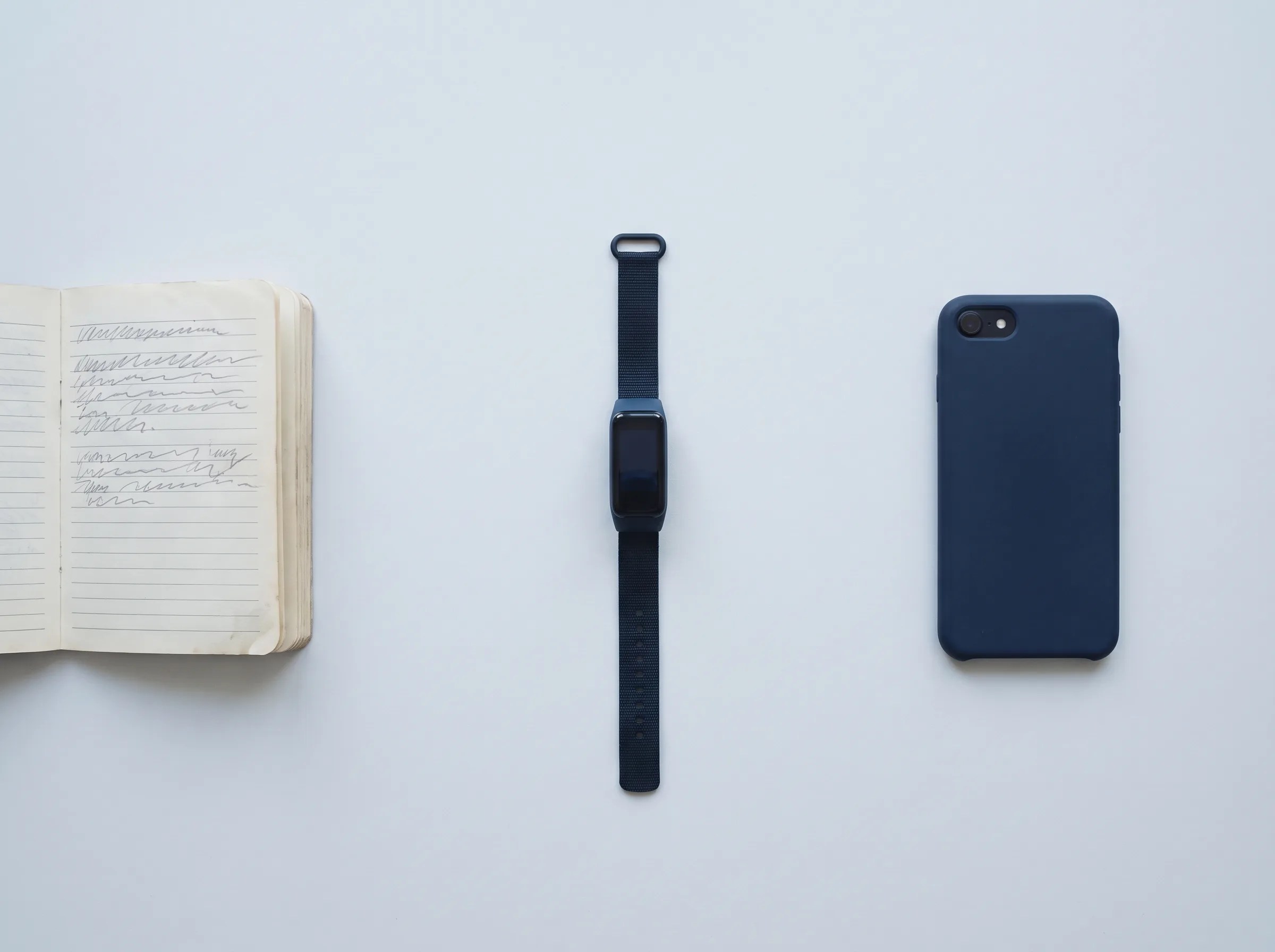
Partly, and for a more interesting reason than “trackers are inaccurate”. Yoon Jae Lee and colleagues pooled 24 studies and 798 participants wearing Fitbit, Garmin, WHOOP, Apple Watch and others against polysomnography. The devices differed significantly on every parameter: total sleep time by −16.9 minutes (95% CI −26.3 to −7.4), sleep efficiency by −4.7 points, sleep latency by +2.6 minutes and wake after sleep onset by +13.3 minutes (4.5 to 22.0).
A constant bias of that kind is the harmless part: if the device shortens every night by a quarter of an hour it shortens both blocks, and the difference between them survives. What does not survive is the scatter around that average, which is why a single night proves nothing while a seven-night block can still show a shift — the same caution behind the research linking REM sleep to disease risk through wrist trackers. Use one device throughout, and leave the sleep-stage breakdown out of your conclusion.
Which change should you test first?
Cheapest and most reversible first, because a sleep experiment costs two weeks whatever you are testing. A fixed wake time, morning light and caffeine timing cost nothing and are covered in our practical guide to better sleep and the evidence-ranked fall-asleep methods. Room temperature and sound come next.
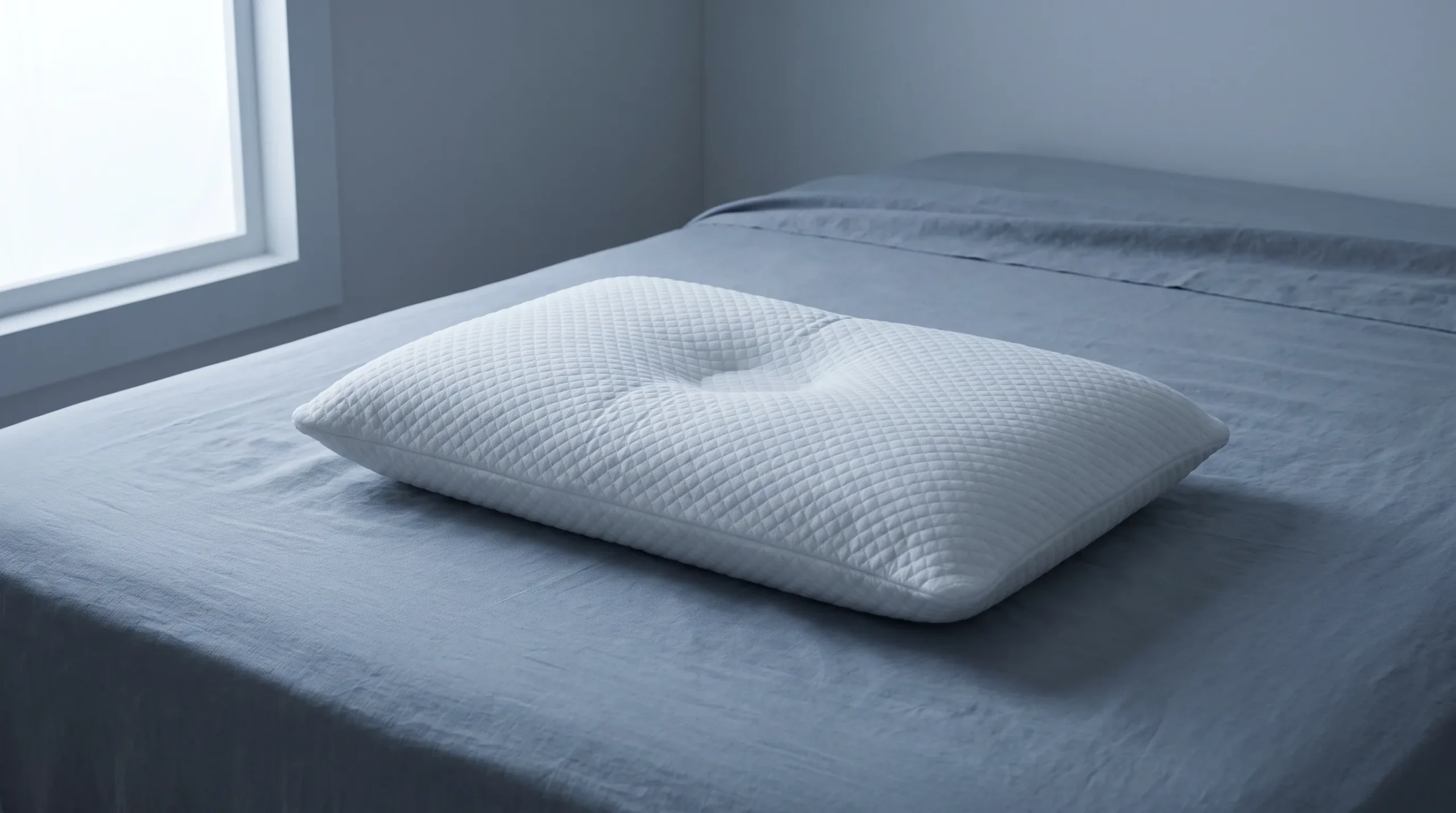
Bedding belongs later in the queue but is the easiest clean swap: one object, one night of installation. The FirmNest Extra Firm Pillow, for example, is 64 × 40 × 14 cm with a 1.5 kg core, so the loft and firmness under test are fixed quantities rather than impressions. Two cautions: new foam changes over the first nights, so separate break-in from the wrong loft using our guide on whether to return a pillow that feels worse; and if you change position overnight, judge it on the position you hold longest.
And if you stay tired in a way these tests keep failing to explain, the question has moved beyond bedding.
Frequently asked questions
How long does a sleep experiment need to run?
A baseline week, then seven nights per condition — three weeks end to end for a clean answer, or a fortnight if you already know your baseline. Five nights were enough for “very good” reliability on a weekly mean in 107,144 nights of tracker data; seven buys the weekday-weekend mix and one spare night.
Do I need a baseline week before I change anything?
It is the single most useful addition. Regression to the mean means an unusually bad week is followed by a better one on its own, and the effect is stronger when you pick the start point by how bad things are. A baseline week gives you something to compare against other than memory.
Can I test two changes at once to save time?
Not if you want to know which one did it. Two simultaneous changes produce one result and two candidate explanations. The faster route is a shorter list: test the change with the lowest cost first, keep the winner, then test the next.
Is my sleep tracker accurate enough for this?
For a block-against-block comparison, usually. Across 24 studies, wrist devices underestimated total sleep time by about 17 minutes against polysomnography — but a constant bias applies to both of your blocks and largely cancels when you subtract them. Keep one device throughout, read whole blocks rather than single nights, and ignore the sleep-stage breakdown.
Should I look at my sleep score every morning?
It is better not to during the experiment. Invented sleep-efficiency feedback was enough to lower alert cognition (d = 0.79) and raise sleepiness and fatigue (d = 0.55) in people with insomnia. Reading a score daily turns your expectation into part of the result you are measuring.
What should I write down each morning?
The Consensus Sleep Diary core items — bedtime, how long you took to fall asleep, number and length of awakenings, final wake time, rise time and a quality rating — filled in at a fixed time before you check any device. It is written at a third-grade reading level and is the instrument researchers compare across studies.
What if the result is “no difference”?
That is a result, and a useful one. The change is not worth its cost for you, and the next candidate can have the slot. The pooled evidence on sleeping pills and on cooling bedding both show how often a confident claim survives only because nobody checked it against a control.
Reading your own result without fooling yourself
A finished sleep experiment gives you a number and a judgement. The number is the difference between two seven-night blocks on one measure; the judgement is whether that difference is larger than the noise in your instrument and larger than what a better week would have produced anyway. If it is not, the honest reading is “not demonstrated”, which still beats “I think it helped”.
Where the variable is bedding, loft and firmness are published quantities rather than feelings, so the same test can be repeated. Figures below are based on the maker’s production specifications; the research above is published work rather than an in-house trial. Readers with persistent poor sleep or ongoing neck pain should speak to a clinician.
Advertisement

FirmNest Extra Firm Pillow
64 × 40 × 14 cm, 1.5 kg extra-firm memory-foam core.
See the FirmNest Extra Firm Pillow on AmazonProducts mentioned in this guide
 Aeris Contour Pillow — 60 × 40 cm, 12–10 cm contour profile, 1.4 kg memory foam core
 FirmNest Extra Firm Contour Pillow — 60 × 40 cm, 12–10 cm contour profile, extra-firm 1.4 kg core