Last updated: September 2026
A new UK Biobank study links more REM sleep to lower risk of 83 diseases. It is the largest look at sleep stages yet, and I think the number travelling around the internet is the least useful thing in it.
The study, published in PLOS Medicine on 17 September, followed 95,559 adults for a median of 8.9 years after each wore a wrist accelerometer for one week. The authors scanned 1,049 health outcomes and found 156 associations. More REM sleep tracked with lower risk across 83 of them, including heart failure and dementias; more deep sleep tracked with lower risk across 7, including type 2 diabetes.
The stages were estimated, not recorded
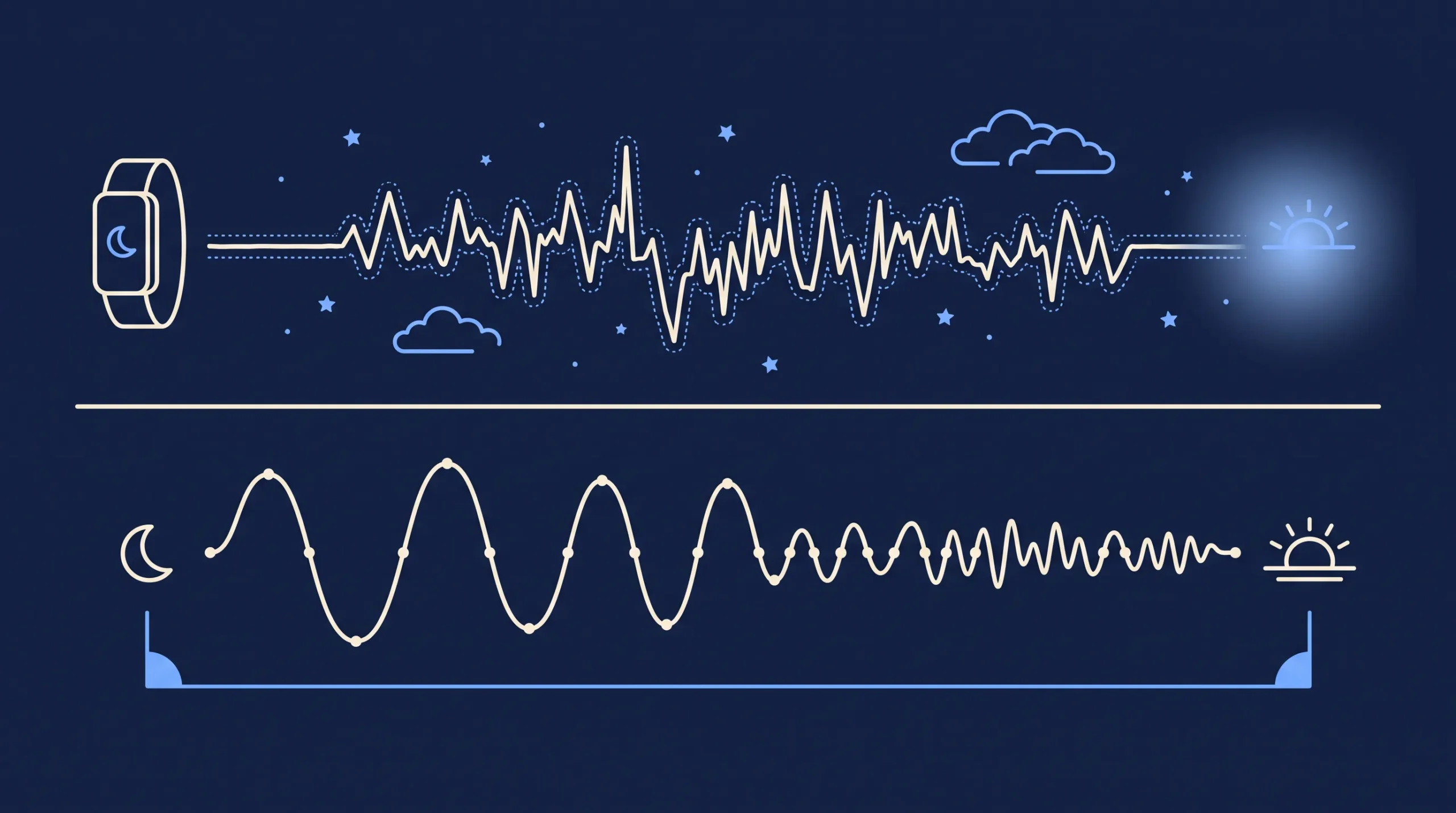
Here is the part the headlines skipped. Nobody in this study slept in a lab. Sleep stages were reconstructed by a deep-learning model called SleepNet, reading wrist motion. The authors report its REM/NREM/wake classification at an F1 score of 0.49 — which they themselves describe as moderate, and typical for motion-based staging. Against clinical recordings, the model was off by an average of 48.2 minutes on total sleep and 17.1 minutes on REM.
That does not make the work weak — the methodology section states all of it plainly. It makes the headline noun wrong. What was measured is movement; REM is the inference drawn from it.
Two sleep scientists said as much the day the paper landed. In the Science Media Centre’s expert reaction, Dr Greg Elder of the Northumbria Centre for Sleep Research noted that movement-based watches “can’t yet accurately determine what sleep stage we are actually in overnight.” Dr Nina Rzechorzek of the University of Cambridge went further, calling the claim in the accompanying press release that 6–8 hours “can effectively reduce” disease risk a statement that “goes beyond what this study design can establish.”
Reverse causation eats a third of it
To be fair to the critics, the authors ran that test themselves and published the result. When they excluded anyone diagnosed within two years of wearing the accelerometer — the window where an undiagnosed illness could be disturbing sleep rather than the reverse — 95 of the 156 associations survived. Sixty-one did not.
A third of the findings, in other words, are consistent with sick people sleeping badly before anyone told them they were sick. Parkinson’s disease is the cleanest example: fragmented REM sleep is a recognised early sign of it, sometimes years ahead of diagnosis.
What a reader can actually use
Strip out the parts that cannot bear weight and something solid is left, and it is not a number you can chase. The minimum-risk window for 69 of the 86 non-linear outcomes sat between 6 and 8 hours. That lines up with a separate 2026 Nature paper from Columbia, which charted sleep duration against 23 biological ageing clocks and found the lowest biological age gap between 6.4 and 7.8 hours. Two different designs, two different measurement methods, one overlapping answer.
The study also flagged irregularity and time spent awake after falling asleep as risks in their own right. Those you can influence. Bedtime consistency is dull advice, which is presumably why it never makes a headline.
REM is not. You cannot dial it up on request, and nothing sold to you — app, supplement, mattress or pillow — has been shown to raise it on demand. This study tested no intervention at all. It watched people sleep and waited nine years.
So read the 83 as a map of where sleep and illness travel together, not a target. If you want to act on it tonight, the usable instructions are the ones we already had: keep the hours regular, aim for six to eight of them, and treat anything promising to engineer your sleep stages with the same suspicion the researchers applied to their own algorithm. Persistent sleep problems belong with a doctor, not a dashboard.
Advertisement

FirmNest Extra Firm Pillow
64 × 40 × 14 cm, 1.5 kg extra-firm memory-foam core.
See the FirmNest Extra Firm Pillow on Amazon