Last updated: September 2026
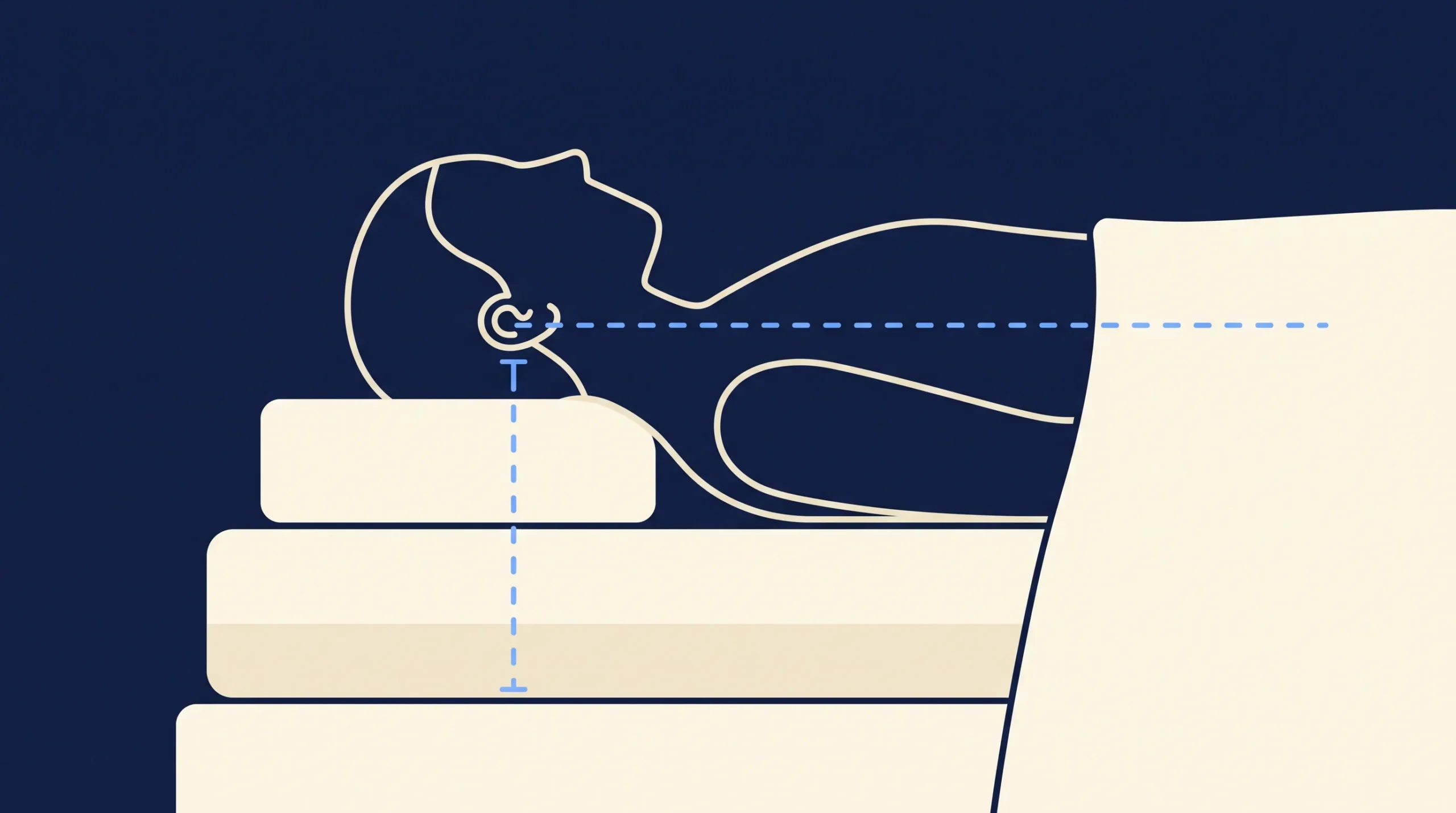
A high-loft pillow is the one sized to the gap between your ear and the mattress when you lie on your side, and these two makers fill that gap differently: SOFTGAS puts two lofts in one pillow, CHYNIQUE sells two sizes.
Which is to say the choice here is not really between two pillows, it is between two ways of being sized. Methodology: every figure below comes from each maker’s own Amazon listing, read on 18 September 2026; nothing here comes from sleeping on either product.
Key takeaways
- The SOFTGAS High Loft Memory Foam Pillow states one pillow, 26 × 16.5 inches, carrying two contour lofts of 4.7 and 6.1 inches, so the fitting happens after the box is open.
- The CHYNIQUE High Profile Bed Pillow states two separate sizes, 5.5 inches (14 cm) and 6.3 inches (16 cm), and ties each one to a measured shoulder width: 54-60 cm and over 60 cm.
- CHYNIQUE is the only one of the two that publishes a fitting rule, and it is also the only one that never publishes the pillow’s length and width.
- The CHYNIQUE title calls the support “Thick Firm”; its own bullets call the same pillow “Medium Firm” twice. The listing does not resolve this.
- Both are memory foam, both say “high density”, and neither gives a density figure, a weight, a warranty or a foam certification.
- Research on loft is built around body dimension, not a universal number, which is the strongest argument for CHYNIQUE’s approach and the strongest argument against buying either one blind.
How do the SOFTGAS and CHYNIQUE pillow specs compare?
Both are sold to the same shopper: a side sleeper whose shoulder lifts the head further off the mattress than an average pillow can reach. Both answer with memory foam and a contoured surface. The divergence is in how the buyer arrives at a loft.
| Spec (maker’s listing) | SOFTGAS High Loft | CHYNIQUE High Profile |
|---|---|---|
| Loft options | 4.7 in and 6.1 in, both in the same pillow | 5.5 in (14 cm) and 6.3 in (16 cm), sold as separate sizes |
| How the loft is chosen | After purchase, by switching between the two contour heights | Before purchase, by picking the size that matches a stated shoulder width |
| Stated fitting rule | None | 6.3 in for shoulder widths over 60 cm; 5.5 in for 54-60 cm |
| Stated surface size | 26 × 16.5 in | Not stated; the overview lists only the height |
| Fill | Memory foam, described as high density, no figure | Memory foam, described as high density, no figure |
| Firmness grade | Not stated | “Medium Firm” in the bullets; the title says “Thick Firm Support” |
| Surface | Contoured, with a raised neck section | Contoured, described as supporting head, neck and shoulders |
| Cover | Listed as a removable cover; material, washing and closure not stated | Removable zippered cover, machine washable, described as breathable and hypoallergenic |
| Colour options | White | White |
| Marketed for | Side sleepers, broad shoulders, larger frames, gym-goers | Side sleepers with broad shoulders, larger frames, desk workers |
| Positions claimed | Side and back | Side, back and stomach |
| Weight, warranty, foam certification | None stated | None stated |
Source for every cell: each product’s Amazon listing, read 18 September 2026. Centimetre figures in the CHYNIQUE column are the maker’s own; the SOFTGAS lofts convert to roughly 11.9 and 15.5 cm by our arithmetic.
What design choices set these two high-loft pillows apart?

SOFTGAS builds the decision into the object. One pillow carries two contour lofts and the sleeper moves between them, which is the safer purchase when you do not know your own number. The listing is also the more cautious of the two about where the pillow belongs, naming side and back sleeping and opening with a warning that it is meant for people who want a taller surface.
CHYNIQUE builds the decision into the catalogue: two sizes, each with a shoulder-width band attached, the taller labelled for men and the shorter for women. The gendered label is the weaker part of an otherwise better idea, since the criterion the maker publishes is a measurement in centimetres and a measurement does not need a gender attached to it. Where CHYNIQUE overreaches is in claiming the same pillow suits stomach sleepers, as a 6.3-inch surface is close to the opposite of what flat-front sleeping asks for; our guide to choosing a pillow for side sleeping sets out why loft tracks the sleeping position first.
The cover is the quiet difference. CHYNIQUE states a zippered, removable, machine-washable cover; SOFTGAS lists “removable cover” as a feature and then says nothing about fabric, closure or washing. On a foam pillow the cover is the part that meets skin every night and the only part that can be cleaned.
Which sleeper suits a high-loft pillow?
This is guidance drawn from published specs and published research, not advice for any condition; if neck pain is part of a medical picture, work it out with your doctor rather than with a product page.
Start with the geometry, because it is the whole reason this category exists. Lying on your side, the distance from your ear down to the mattress is set by your shoulder, and a pillow that does not reach it lets the head drop. A 2021 review of the evidence published since 1997 puts the mechanism plainly: a pillow that is too high can bend the cervical spine forward, while one that is too low can stretch it backwards. That review also names the body measurement researchers use for the side position — the width from ear to shoulder, not the shoulder breadth across the back.
That distinction matters when reading CHYNIQUE’s rule. Its 54-60 cm and over-60 cm bands are body-breadth numbers, while the research measurement is a much shorter ear-to-shoulder distance, so the two are not the same quantity even though both are called shoulder width.
Support for the idea comes from a 2024 study of nine side sleepers in Medical & Biological Engineering & Computing, which tested foam-latex pillows at 8, 10, 12 and 14 cm with and without a neck section. Rather than looking for one best number, the authors derived an individualised index from each subject’s shoulder width together with the pillow’s absolute loft, and found the cervical curve closest to natural standing, with the lowest modelled musculoskeletal force, in the medium band of that index paired with neck support. Comfort ratings peaked in a slightly lower band — the loft that felt best was not the loft that measured best.
Both products sit at the top of, or above, the range that research has tested. SOFTGAS’s lofts are about 11.9 and 15.5 cm; CHYNIQUE’s are 14 and 16 cm. If your shoulder is broad enough that ordinary pillows leave a gap, that is the argument for being up here; if it is not, the taller options are more pillow than the evidence supports. Our firm pillow guide covers firmness, which decides how much of a stated loft survives your head, and our guide to pillows and neck pain covers the symptoms people arrive with.
Sleepers who spend part of the night on their back are being asked, by both listings, to accept one loft for two positions. An 84-participant study of a structured fitting method found half its participants reached the threshold for a clinically meaningful change in neck-pain scores after their loft was adjusted, with no control group, so it shows the method is worth testing rather than proven. That adjustment was made to the sleeper, not chosen from a catalogue, and SOFTGAS’s two-in-one design is the closer analogue of it. If side sleeping already leaves you stiff, our article on side sleeping and rounded shoulders looks at the wider setup.
How do you measure before you buy either one?
Neither listing tells you how, so this is our procedure, and it takes two minutes with a tape measure and somebody to read it.
Lie on your side on the mattress you actually sleep on, with no pillow, head on your lower arm. Have someone measure vertically from the mattress surface to the middle of your ear. That distance is the gap a pillow has to fill, and it already includes how far your shoulder sinks into your own mattress, which is why it beats any figure taken standing up.
Then subtract, roughly, the compression under your head — which neither maker publishes. That is the honest end of the calculation: you can measure the gap precisely and still have to guess at the compression, which is the strongest argument for the SOFTGAS approach, since two lofts let you settle the guess in your own bed rather than in the returns queue. Our practical better-sleep guide puts this alongside the other things worth fixing before blaming the pillow, and if your complaint sits lower down the spine, our guide to pillows for lower back pain is the better start.
What the listings do not tell you: 6 gaps
Where a spec is missing or stated two different ways, we record it rather than resolve it. These are the questions worth putting to each seller.
- How firm the CHYNIQUE actually is. The title says “Thick Firm Support”; two bullets on the same page say “Medium Firm”. Firmness decides how much of a 6.3-inch loft is still there at 3am, so this is not a wording quibble.
- How big the CHYNIQUE pillow is. The overview lists the size as a height and nothing else, and no bullet gives a length or width. You learn which loft the maker thinks you need, but not whether it fits a standard pillowcase.
- What “shoulder width” means in the CHYNIQUE rule. Across the back? Bideltoid? Ear to shoulder lying down? The bands are specific to the centimetre and the definition is absent.
- What the SOFTGAS cover is and whether it washes. “Removable cover” appears in the feature list; fabric, closure and washing instructions appear nowhere.
- Foam density. Both say “high density” and neither gives a figure — so there is no way to compare how well each holds the loft it was bought for.
- Weight, warranty and certification. Neither states any of the three. CertiPUR-US certifies foams made without formaldehyde, heavy metals or ozone depleters and with low VOC emissions, and publishes a list of participating companies; OEKO-TEX Standard 100 covers the cover.
Frequently asked questions
What is a high-loft pillow?
A pillow tall enough to fill the gap between your ear and the mattress when you lie on your side. There is no industry threshold, but pillows sold this way are generally around 5 inches and up, against roughly 3 to 4 inches for a standard loft. SOFTGAS states 4.7 and 6.1 inches; CHYNIQUE states 5.5 and 6.3.
Do broad shoulders really need a taller pillow?
The broader the shoulder, the further the head sits from the mattress in the side position, so the gap is larger. The 2021 review named above describes a pillow that is too low as letting the cervical spine stretch backwards. How much taller is individual, which is what the 2024 study set out to quantify from body dimension rather than from one recommended figure.
Which is better for a side sleeper who also turns onto their back?
Neither listing publishes a separate figure for the back position, and the research suggests the two positions do not want the same loft. The SOFTGAS carries two lofts in one pillow, so it allows a change without a second purchase; CHYNIQUE asks you to pick one loft and keep it.
How do I choose between the CHYNIQUE 5.5-inch and 6.3-inch sizes?
The maker’s published rule is shoulder width: 54-60 cm for the 5.5-inch, over 60 cm for the 6.3-inch. Since the listing never defines how to take that measurement, the ear-to-mattress gap measured on your own bed is the more reliable check.
Are these pillows machine washable?
CHYNIQUE states a removable zippered cover that is machine washable. SOFTGAS lists a removable cover without stating fabric or washing instructions. Neither listing says the foam core itself can be machine washed.
Is memory foam the right fill for a high-loft pillow?
It holds a stated shape better than loose fills, which is why both makers use it for a contoured surface. The trade is heat and slow response. Neither publishes a density, so how well each holds its loft over time cannot be compared from the pages.
Can a taller pillow make neck pain worse?
It can, and the 2021 review is explicit that too high and too low both push the cervical spine out of its natural curve. Going taller is a fix for a measured gap, not a general upgrade, and persistent pain is a question for a clinician.
Which of the two should you pick?
Pick the SOFTGAS if you do not know your number: two lofts in one pillow settle the question in your own bed, where the compression you cannot look up actually happens, and the stated 26 × 16.5-inch surface tells you what you are getting. Pick the CHYNIQUE if you do know your number and want the taller 6.3-inch option or the stated washable cover — but ask the seller two questions first: how to take the shoulder measurement, and whether the pillow is firm or medium-firm. If you are still working out whether loft is your problem at all, our tips for getting better sleep is the place to start.
Where to buy
Both are sold on Amazon, where the current price, size options, delivery and return terms are shown on each product page. Confirm the size on the day you order: CHYNIQUE sells its two lofts as separate size options under one listing, so the loft you receive is the one selected at checkout.
SOFTGAS High Loft Memory Foam Pillow · CHYNIQUE High Profile Bed Pillow
Advertisement

FirmNest Extra Firm Pillow
64 × 40 × 14 cm, 1.5 kg extra-firm memory-foam core.
See the FirmNest Extra Firm Pillow on Amazon